
Purpose, scope and evidence
Prepared for the Municipal Mayor and Sangguniang Bayan of Busuanga, Palawan. Proposed planning horizon: 2027–2032. This is an independently prepared desk-based strategic development and pre-feasibility study for LGU review. It follows a JICA-style structure—baseline, alternatives, project design, financial screening, safeguards, results and implementation—but is not a JICA study, approval or funding commitment. Municipal insignia identifies the intended LGU; this draft is not an adopted municipal issuance.
The jurisdiction is the Municipality of Busuanga, including all 14 barangays. Coron is a separate municipality and partner market. Busuanga Island, the municipality of Busuanga, Coron town and Coron Island must be coded separately in all datasets. The user’s proposed honey industry, doctor shortage, Digicash Global participation and development priorities are planning inputs requiring LGU confirmation. Digicash Global’s stated role is digital services only; no supplied contract or fee schedule has been verified.
Study edition: October 2026, Asia/Manila. Official records were preferred; observation dates and statistical reference years are stated. Publicly inaccessible or incomplete information is recorded as a gap, not filled with invented figures. Financial envelopes, targets, demand elasticities, event attendance and benefit scenarios are analyst assumptions. None is a procurement estimate or an observed local outcome.
| Evidence class | Use in this study |
|---|---|
| Verified record | Published government figures, downloaded BIR workbook, dated DOT tables and official clinic list. |
| Operator / market observation | Hotel statements and property asking prices; current capacity or achieved sale remains unconfirmed. |
| User-provided proposal | Priority programs, digital-services partner, reported doctor shortage and mayor’s ability to provide local records. |
| Planning assumption | Costs, targets, pilots, scenarios and economic models explicitly labelled illustrative. |
| Pending field validation | Municipal production, full Busuanga room count, local spend survey, project sites, utilities and engineering. |
Data limitations that affect investment decisions
- Coron has an official 2023 capacity survey; a complete current Busuanga municipal room total was not found. This study provides a named working inventory and dated room observations, not a fabricated total.
- A 2024 Coron accomplishment report was downloaded, but tourism tables were not identifiable in its text layer. Its publication year is not used to update the verified 2023 figures.
- No verified municipal tourism-receipts total, current household poverty rate, farm-output inventory, honey sales total or doctor headcount is asserted.
- Detailed MIMAROPA RDIP entries and current grant allocations were not retrieved. Programme alignment is proposed; funding is not secured.
- The BIR portal provides the 2017 second-revision schedule. Any approved replacement SMV must be checked with BIR/BLGF and the Palawan assessor before transactions.
The Mayor’s decision agenda
Make tourism purchase more from residents, make basic food more affordable, and make public services easier to use. The recommended development model is an island supply-and-service economy: farmers, fisherfolk, food makers, transport operators and young workers earn from resident demand and visitor spending, while dependable health care, utilities and environmental management support both. Growth should raise net household income and retained local value—not only visitor counts.
- Launch basic goat and small-platform salt livelihood pilots in the first 100 days, alongside honey quality improvement and school/home food production. Their low entry scale justifies early action; expansion still depends on health, site rights, food safety, seasonal performance and actual sales.
- Secure hotel purchasing commitments before expanding production and cold storage. Start aggregation, crates, scheduled delivery and rented refrigeration first.
- Use interoperable LGU systems and interoperable digital payments, with assisted and cash access. PusoPay is a proposed service channel, subject to validated functionality and contracting.
- Strengthen the existing accredited YAKAP clinics through a Busuanga–Coron clinical partnership. Digital systems support clinical capacity; they do not supply doctors.
- Create a distinctive food-and-culture experience and pilot Busuanga Baydays, a beach, food and music weekend. Tie every promotion to available rooms, safe transport and bookable local experiences.
- Prepare two or three investable hotel opportunities with qualified private owners. Seek a brand conversion or management/franchise arrangement before assuming a large new resort is viable.
- Screen hydro with dry-season flow, head, ecological and cost data. Energy efficiency and solar-assisted essential facilities are earlier candidates.
| Decision requested | First deliverable | Responsible lead |
|---|---|---|
| Create a municipal delivery unit | Named project owners, evidence register and monthly dashboard | Mayor / MPDO |
| Start basic livelihoods | Salt platforms, forage-first goat pilot, honey tests and buyer orders | Municipal Agriculture Office (MAO) |
| Authorize an island food compact | Joint hotel–producer demand survey and pilot delivery route | MAO / Tourism / Coron counterparts |
| Pursue joint care | Clinical staffing and referral agreement using existing clinics | Municipal Health Offices (MHOs) / Province |
| Prepare visitor and investor products | Event concept, bookable itineraries and hotel data room | Tourism / investment focal person |
| Approve only preparation funding initially | PHP3.0 million indicative first-100-day ceiling, subject to appropriation | Budget / Treasurer / Sanggunian |
People, geography and economic baseline
| Indicator | Verified value | Reference / geography |
|---|---|---|
| Busuanga residents | 26,974 | 1 July 2024 census [S1] [S2] |
| Busuanga residents, earlier census | 25,617 | 1 May 2020 [S2] |
| Population growth | 1.25% annually | 2020–2024, PSA published rate [S2] |
| Land area | 392.90 km² | PSA municipal profile [S1] |
| Barangays | 14 | Municipal brochure / census table [S1] [S3] |
| Coron residents | 69,439 | 1 July 2024 census [S2] |
| Coron tourist arrivals | 286,000 | CY2023 Tourism Office report [S5] |
| Coron accommodation capacity | 167 establishments; 2,778 rooms; 7,852 beds | CY2023 municipal survey [S5] |
| Palawan domestic visitor arrivals | 945,210 | 2023 DOT table reproduced by PSA; provincial context, not Busuanga [S1] |
| Palawan goat production | 1,127.36 metric tons | 2024 provincial livestock production; not local herd size [S1] |
Busuanga’s resident count increased by 1,357 between the two census dates, or approximately 5.3% overall, calculated from PSA figures. The island’s tourism demand is shared, but income and public service responsibility are municipal. Airport passengers cannot be equated to tourists: counts may include residents, workers, repeat travel and both arriving and departing passengers. [S2] [S43]
| Barangay | 2024 residents |
|---|---|
| Bogtong | 1,199 |
| Buluang | 3,139 |
| Cheey | 3,270 |
| Concepcion | 1,920 |
| Maglalambay | 1,376 |
| New Busuanga | 2,033 |
| Old Busuanga | 1,139 |
| Panlaitan | 3,161 |
| Quezon | 890 |
| Sagrada | 1,595 |
| Salvacion | 3,665 |
| San Isidro | 1,297 |
| San Rafael | 912 |
| Santo Niño | 1,378 |
PSA 2025 Countryside in Figures, Table 1.5; counts sum to 26,974. [S1]
Working diagnosis: earnings may leak off-island through imported food, specialized services and external booking channels; losses and transport costs may raise delivered food prices; staff shortages and unreliable services may constrain expansion. These are hypotheses to test, not measured local leakage percentages. The historic ECAN plan identifies conservation-sensitive resources and livelihood needs; its older employment and poverty statistics are not used as current evidence. [S22]
A spatial strategy for the whole municipality
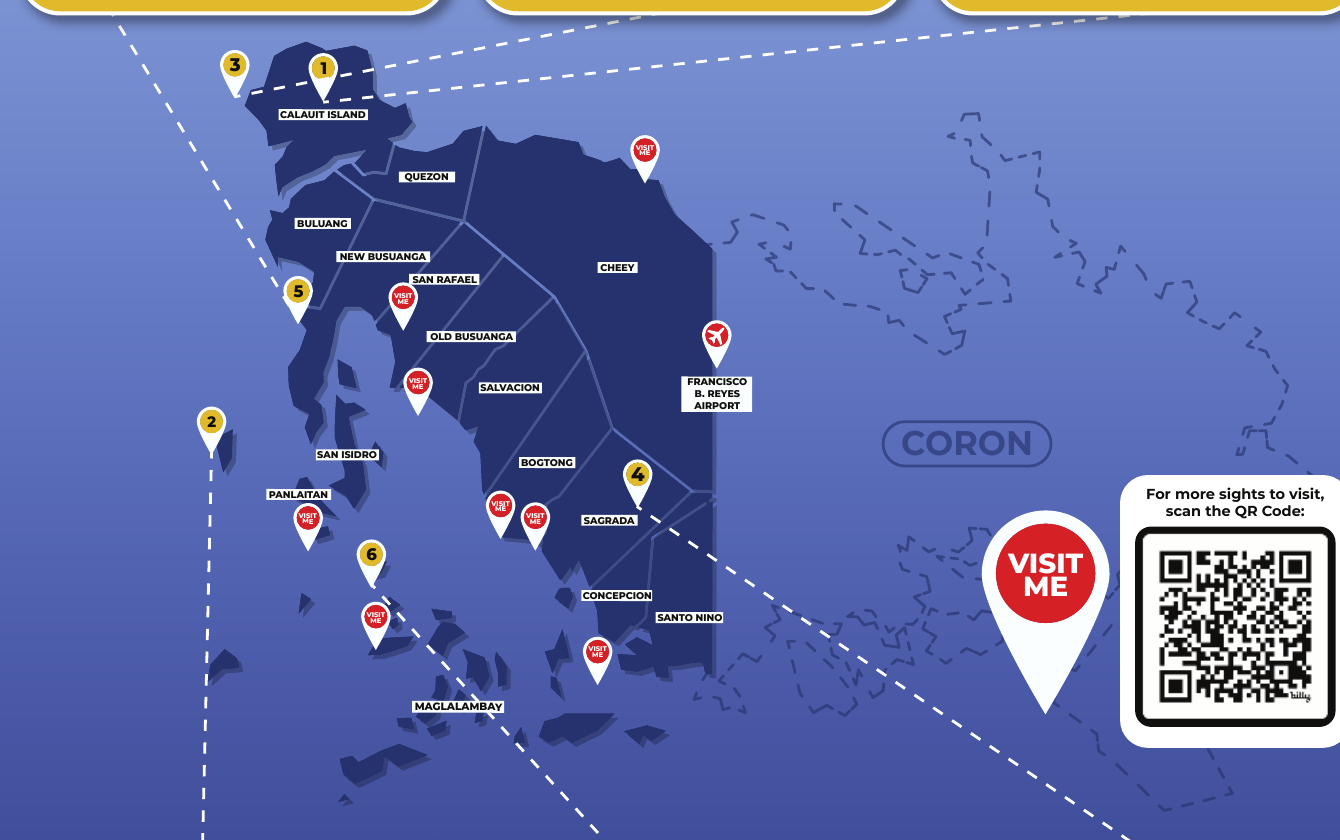
| Planning cluster | Proposed role | Evidence required before location selection |
|---|---|---|
| Salvacion and nearby settlements | Public services, collection/dispatch, training and resident food market | Title, zoning, road access, power, water and service radius |
| Concepcion–Sagrada–Bogtong corridor | Resort supplier services, food experiences and marine-service jobs | Hotel purchasing map, existing commercial sites and shore restrictions |
| New/Old Busuanga–Buluang–Quezon–Cheey | Farm/honey visitor experiences, basic goats and candidate salt demonstrations | Soil/water tests, forage rights, coastal-water quality and community consent |
| Panlaitan–Maglalambay and other island/coastal communities | Fish handling, delivery links, outreach access and locally operated tours | Boat safety, landing points, cold-chain timings and care/referral routes |
| Coron partner market / airport gateway | Hotel offtake, shared training, airline dialogue and medical referral | Inter-LGU agreements; no assumption of control by Busuanga |
Clusters describe functions, not designated project sites. Every barangay receives a livelihood and service-access screening. Reserve participation for remote communities rather than concentrating support around resorts. Use a single GIS register linking official barangay boundaries, parcel identifiers, farms, landing sites, roads, clinics, schools and candidate investments; suppress household and patient identifiers from public maps.
- Overlay current PCSD ECAN zoning and protected areas with CLUP, NCIP ancestral-domain information, coastal easements and DENR land classification. Historic maps cannot establish current development rights. [S22] [S33]
- Use HazardHunterPH for an initial parcel check, then obtain appropriate official hazard reports and site surveys for flood, landslide, storm surge and other relevant risks. [S32]
- Map actual wet- and dry-season delivery times and clinic travel times, including boat transfers. Straight-line distance does not measure access burden.
- Show an approved no-build and no-event zone map before investor marketing. A beautiful waterfront is not automatically a permissible venue or hotel site.
Seasonality, resilience and investment timing
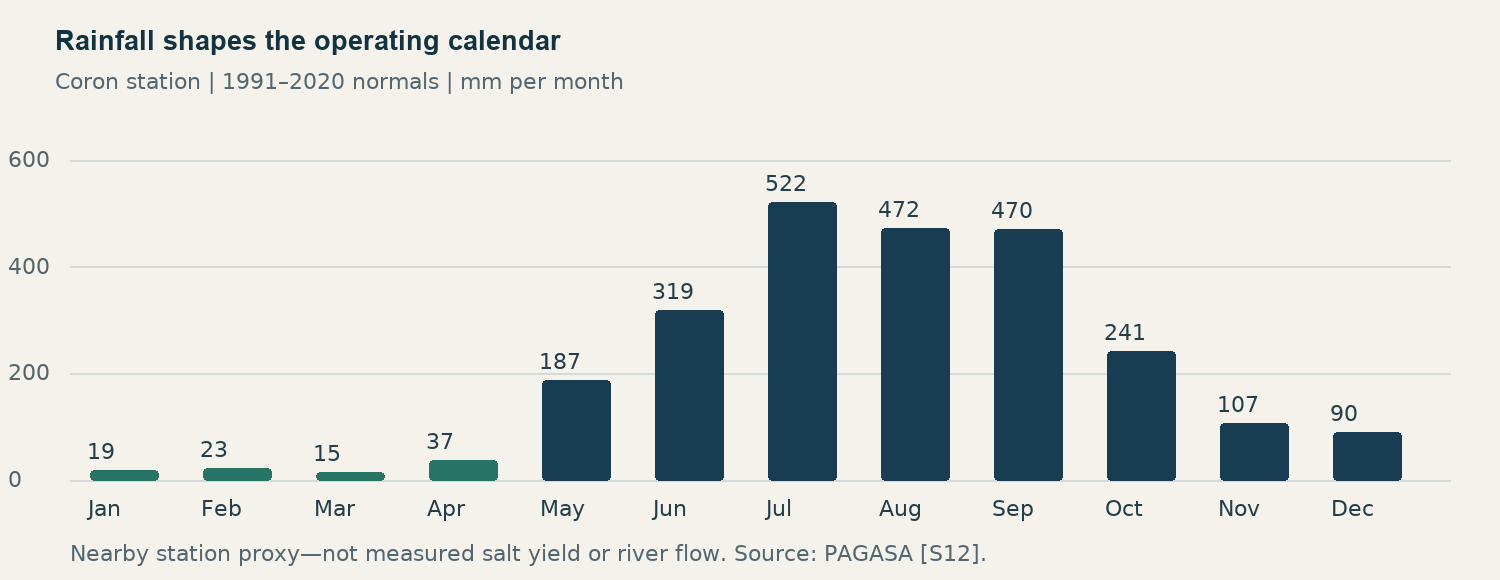
January–April have lower normal rainfall than the mid-year months at the Coron station. This supports testing open-air salt production in the drier season, protecting food production in the wetter season and providing indoor alternatives for visitor products. It does not prove a salt yield or dependable hydropower resource. The annual rainfall total cannot replace dry-season river measurements. [S12]
| Exposure | Design response | Decision evidence |
|---|---|---|
| Heavy rain and storms | Raised equipment, covered handling, drainage, venue evacuation and shipment alternatives | Parcel hazard report and drainage design |
| Dry-season water constraints | Water audit, storage, efficient irrigation, forage reserve and hotel water budgets | Measured source yield and lawful abstraction |
| Power interruption | Temperature alarms, maintenance response and engineered backup for critical refrigeration/clinics | Utility outage logs and equipment heat-load study |
| Tourism shocks | Resident market, institutional food demand and flexible staffing | Monthly demand and cash-flow downside tests |
| Coastal ecology pressure | No mangrove clearing for salt/hotels; protect seagrass and wildlife areas | PCSD/DENR/NCIP and community checks |
Hotel and accommodation inventory
Coron’s 2023 municipal survey is the most complete official local capacity baseline retrieved: 167 establishments, 2,778 rooms and 7,852 beds. These figures are historical and are not limited to DOT-accredited properties. Busuanga’s municipal tourism directory names 11 establishments, but supplies no total room inventory. The three Busuanga properties identifiable in the DOT 2023 resort table have 65 rooms/units combined; this is a documented subset only. [S4] [S5] [S6]
| Municipality / establishment | Published count | Basis / status |
|---|---|---|
| Busuanga • Busuanga Bay Lodge | 41 units | DOT2023; operator says 38 rooms + 3 two-bedroom villas [S6] [S48] |
| Busuanga • La Estancia | 15 | DOT2023 historical rooms [S6] |
| Busuanga • Marina del Sol | 9 | DOT2023 historical rooms [S6] |
| Busuanga • Awapuhi | Not published in retrieved directory | Municipal directory [S4] |
| Busuanga • Ocam-Ocam Sunset-Bay Guest House | Not published | Municipal directory [S4] |
| Busuanga • Brian’s Lodging House | Not published | Municipal directory [S4] |
| Busuanga • The Beach House Ocam-Ocam | Not published | Municipal directory [S4] |
| Busuanga • Stone Manor Inn | Not published | Municipal directory [S4] |
| Busuanga • Hilarios Inn | Not published | Municipal directory [S4] |
| Busuanga • Josefina’s Tourist Inn | Not published | Municipal directory [S4] |
| Busuanga • White Summerville Tourist Inn | Not published | Municipal directory [S4] |
| Coron • Bacau Bay | 80 | DOT2023 [S6] |
| Coron • Coron Westown | 79 | DOT2023 [S6] |
| Coron • Corto del Mar | 33 | DOT2023 [S6] |
| Coron • The Funny Lion | 31 historical / 46 property-page report | DOT2023 vs operator; other operator page says 32 [S6] [S49] |
| Coron • Two Seasons Bayside | 48 | Operator report [S50] |
| Coron • Two Seasons Island | 42 historical / 46 accommodation units reported | DOT2023 vs 42 bungalows + 4 casitas [S6] [S51] |
Do not sum the mixed-date operator counts into a current municipal total or add them to the Coron survey. Rooms, bedrooms, villas, units and beds require separate fields. Island resorts marketed as “Coron” may lie in different municipalities; tax-address and parcel verification must control assignment. Club Paradise/Discovery Coron and El Rio y Mar are excluded from the Busuanga subtotal pending jurisdiction verification; marketing names alone are insufficient.
A 30-day LGU inventory update
- Tourism offices and BPLOs provide every active, inactive and pending accommodation business, with barangay, physical address, GPS, business permit and DOT accreditation validity.
- Ask operators for sellable rooms/units and beds, closures, expansion plans, monthly occupancy, average daily rate (ADR), guests and average stay. Aggregate confidential business metrics publicly.
- Record actual booked rooms for event dates. A historic room total does not establish festival capacity; transport, water, staff and emergency capacity may bind first.
- Publish separate Busuanga and Coron tables with reference date, reconciliation rules and unresolved cases. This inventory becomes the supplier-demand and international-brand data room.
Tourist arrivals, revenue and local retention
Verified arrivals are a demand signal, not money collected. Coron recorded 286,000 tourist arrivals in 2023 and also reported cruise arrivals separately; this study does not add the latter because inclusion in the total is unclear. No verified annual Busuanga arrivals or tourism-attributable municipal revenue total was retrieved. The following monetary scenarios are estimates using explicit assumed spending—not official receipts. [S5]
| Coron 2023 scenario | Arrivals × assumed stay × assumed daily destination spend | Illustrative direct visitor expenditure |
|---|---|---|
| Low | 286,000 × 2.5 days × PHP2,500 | PHP1.788 billion |
| Central | 286,000 × 3.0 days × PHP3,500 | PHP3.003 billion |
| High | 286,000 × 4.0 days × PHP5,000 | PHP5.720 billion |
Scenarios assume arrivals are visitor trips compatible with stay assumptions. Cruise/day visitors need separate treatment; figures are not municipal revenue, GDP or verified turnover.
Daily destination spending includes allocated accommodation, food, local transport, tours and retail. It excludes airfare paid outside the destination. Do not add hotel receipts again to this total. No tourism multiplier is applied. Local retained value is the portion paid as resident wages, local supplier margins and locally retained operating surplus; purchases of imported inputs must be deducted. A survey and supplier accounts are needed to measure it.
| Busuanga planning example | Calculation | Illustrative result |
|---|---|---|
| Municipal visitor spending | 20,000 visitor trips × 3 days × PHP3,000/day | PHP180 million/year |
| Food-and-beverage spending | 30% of destination spend | PHP54 million/year |
| Food purchasing pool | Assume ingredient procurement equals 35% of food-service sales | PHP18.9 million/year |
| Additional local supplier sales | 10 percentage-point local purchasing shift × PHP18.9m procurement pool | PHP1.89 million/year gross sales |
| Local retained value scenario | 35%–55% of PHP180m | PHP63m–99m/year; assumed, not measured |
20,000 visitors is a model input, not the Busuanga baseline or a forecast. Ingredient spending is distinct from visitor food spending; supplier sales are not net farmer income.
Municipal fiscal attribution
The Treasurer should reconcile tourism-coded business taxes, permits, lawful user/environment fees, rents and economic-enterprise income to receipts and general-ledger accounts. Attribute only the applicable municipal share; national taxes and provincial/private collections are separate. Report gross collection, refunds, collection cost and restricted environmental use. Do not infer LGU revenue by multiplying visitors by a fee unless rate, exemptions, actual paying visitors and collecting jurisdiction are confirmed.
- Request 2022–2026 monthly arrivals by visitor type, accommodations and entry method; establish duplicate and day-visitor rules.
- Use exit surveys for destination nights, spending by category, flight route, paid all-in fare and whether guests stayed in Busuanga or Coron.
- Cross-check hotel nights against rooms × open days × occupancy × guests/room; reconcile timing and visitors staying with friends.
- Use observed spending and accounts to replace assumptions before hotel or municipal borrowing decisions. Publish estimates with uncertainty intervals and methodology.
Airline pricing sensitivity and island tourism
Airline prices affect the visitor’s total trip cost, booking timing, length of stay and destination choice. USU serves the wider island visitor economy; Busuanga benefits only from the portion that stays or spends locally. The LGUs can improve route economics and visitor packages, but cannot set airline fares. Coordinate with carriers, CAAP, CAB and DOT; obtain scheduled seats, cancellations, route passenger data and fare observations rather than assuming a runway expansion will automatically lower prices. [S41] [S43]
PAL’s indexed Manila–USU page showed promotional round-trip observations of PHP5,169 for 16–19 October 2026 and PHP7,131 for 13–16 October 2026 when researched on 13 October. These are different departure dates and limited promotional offers, not comparable market averages or guaranteed current quotes. They illustrate why fare monitoring must fix booking lead time, dates, baggage, fees and refund conditions. No elasticity is estimated from these two observations. [S42]
Transparent scenario model
Let s be airfare’s share of total trip cost, f the fare change, and e the assumed elasticity of destination visits to total trip cost. Total-trip-cost ratio = 1 + s × f. Visit ratio = (1 + s × f)^e. Illustrative s = 35%; e = −0.5, −1.0 or −1.5. These are sensitivity assumptions, not measured Busuanga elasticities. This is a total-cost model, not an airfare-only elasticity model; applying both would double-count the price effect.
| Fare change | Trip-cost change | Visits: e=−0.5 | Visits: e=−1.0 | Visits: e=−1.5 |
|---|---|---|---|---|
| -20% | -7.0% | +3.7% | +7.5% | +11.5% |
| +10% | +3.5% | -1.7% | -3.4% | -5.0% |
| +20% | +7.0% | -3.3% | -6.5% | -9.7% |
| +30% | +10.5% | -4.9% | -9.5% | -13.9% |
Constant other trip costs, service quality and capacity; rounded scenario changes. Web simulator exposes editable inputs.
Central example: a 20% fare increase raises total trip cost by 7%; assumed e=−1 gives 6.5% fewer visitor trips. At the illustrative 20,000-trip Busuanga baseline, that is about 1,308 fewer trips and PHP11.78 million less destination expenditure at three days and PHP3,000/day. Food spending falls about PHP3.53 million at a 30% share. These are gross revenue changes; employment cannot be converted without staffing and productivity data. These assumptions do not use Coron’s 2023 arrivals as Busuanga’s baseline.
What the Mayor and tourism businesses can do
- Create a Busuanga–Coron air-access working group and a weekly comparable all-in fare basket at 7, 30, 60 and 90 days before travel, covering domestic gateways actually operating. Track median fares and seats, not only advertised lows.
- Offer shoulder-season three-night packages with transparent air/room/transfer prices, flexible dates and small allocations of real rooms. Test marketing against confirmed bookings and net contribution.
- Use events and hotel room blocks to demonstrate incremental demand to airlines. Do not guarantee public seat purchases or airline losses without a separately appraised and authorized arrangement.
- Reduce avoidable destination costs through coordinated transfers and local food supply. Check whether savings reach guests and residents rather than assuming a lower input cost lowers retail prices.
- Model independent fare (+20%), seats (−10%), visit-spend (−10%) and occupancy shocks. Lost seats can cap growth even when fares fall; cheaper flights can also shorten stays or divert spending.
- Estimate an empirical route/destination model only after sufficient monthly data. Control seasonality, seats, promotions, income and disruptions; high demand can raise fares, so correlation alone is not causality.
What happens when airfares change?
Change the inputs to stress-test visitor demand and destination spending. All defaults are illustrative Busuanga inputs.
Visit ratio = (1 + airfare share × fare change)^elasticity. Other costs, stay, spend and capacity held constant. Excludes airfare from destination spending. Values do not estimate LGU revenue or jobs.
Real estate: asking prices and BIR values
A market value requires comparable completed sales and professional appraisal. Public listing prices provide negotiation signals only. The sample below was observed in public listings on October 2026; availability, title, precise location, improvements, taxes and land-use rights were not independently verified. Price per square metre is recomputed from the listed total and area. Mislabeled municipalities, mixed land/building assets and duplicate listings were excluded from any average. [S10] [S11]
| Advertised location / asset | Area | Asking total | Calculated PHP/m² |
|---|---|---|---|
| Busuanga • roadside/overlooking land; exact barangay unconfirmed | 20,000 m² | PHP36,000,000 | 1,800 |
| New Busuanga • beach property | 31,000 m² | PHP99,000,000 | 3,194 |
| Cheey • beach lot | 34,375 m² | PHP171,875,000 | 5,000 |
| Coron • Poblacion 6, titled-property advertisement | 3,032 m² | PHP9,096,000 | 3,000 |
| Coron • Poblacion 6, Pali property | 4,603 m² | PHP20,713,500 | 4,500 |
| Coron • Dipulao, Poblacion 6 | 2,000 m² | PHP40,000,000 | 20,000 |
Selected heterogeneous asking observations [S10] [S11]. No representative market price range, achieved-sale price or fair-value appraisal is claimed.
Verified BIR schedule examples
The official downloaded RDO 36 workbook identifies DO 072-2017, second revision, effective 23 December 2017. The BIR portal still linked this workbook at retrieval. The rows below are extracted from that schedule; they are not 2026 revaluations. RA12001 establishes a replacement SMV framework; the existence or effectivity of a new Palawan SMV was not confirmed. Check the applicable current schedule with BIR and the assessor before any tax, sale, public acquisition or investor quotation. [S7] [S8] [S9]
| Location / exact schedule context | Class | PHP/m² |
|---|---|---|
| Busuanga • Salvacion, national/provincial road; within 100m from centre line of BR (source wording) | CR | 480 |
| Busuanga • same Salvacion road context | RR | 360 |
| Busuanga • Salvacion interior | RR | 230 |
| Busuanga • Salvacion all lots, seashore | A39 | 1,000 |
| Busuanga • Salvacion all resorts | A40 | 12,500 |
| Busuanga • Buluang, national/provincial road | CR / RR | 310 / 200 |
| Busuanga • Sagrada, Dicilingan Island (Huma Resort) | A40 | 35,000 |
| Coron • Burgos St., Don Pedro St. to Calle Nueva | CR / RR | 15,000 / 10,000 |
| Coron • Calle Nueva, National Highway to Felicidad St. | CR / RR | 8,000 / 5,000 |
| Coron • Fernvale Subdivision | RR | 5,000 |
Source: BIR DO072-2017 workbook. CR=commercial; RR=residential. Preserve agricultural/special class codes and confirm classification with BIR. Full Busuanga/Coron row extract is downloadable. [S7]
Zonal values, assessor schedules and advertised prices are different concepts and must not be multiplied into a supposed market value. The large difference between inland residential and named resort rows shows why matching exact barangay, street, vicinity and classification matters. Resort figures are not the applicable value for every vacant beach parcel.
Investment-site due diligence and municipal opportunity
- Create a voluntary land opportunity register: title/tenure, parcel survey, encumbrances, access, asking terms, water/power, current zoning, ECAN, hazards and NCIP issues. List only owners who consent to investor use.
- Commission comparable-sales appraisal for two or three shortlisted sites. A tax declaration is not proof of title; advertised “island ownership” must be independently examined.
- Prefer lease or owner-funded conversion options where they preserve municipal resources and acceptable tenure. Reserve resident housing and public waterfront access in land-use planning.
- Use the digital cadastral/revenue inventory to improve lawful assessment and collections, with taxpayer notice and applicable exemptions. Do not promise windfall revenue from blanket revaluation.
- Keep land purchases, hotel development, hydro civil works and major roads outside the indicative programme budget until independently appraised.
Explore the BIR schedule
423 source rows from Busuanga and Coron. Current applicability requires BIR/assessor confirmation. Blank raw vicinity cells are preserved; consult the original workbook for merged-cell context.
| Barangay / municipality | Street context / raw vicinity | Class | PHP/m² | Workbook row |
|---|
Food security and affordable island supply
Objective: increase reliable, safe local supply while reducing avoidable losses and delivered cost for residents and hotels. Begin with a demand-led mix of locally suitable vegetables, roots, eggs, fish and meat; do not promise complete rice, dairy or wheat self-sufficiency. SEARCA’s island school/home garden work provides a partner and learning base. Obtain its endline findings and identify the participating schools before expanding. [S20] [S21]
| Workstream | First-year action | Proposed verification |
|---|---|---|
| Demand and prices | Survey all willing hotels; sample markets weekly; record purchasing units, grades, prices and rejected deliveries | 12-month demand calendar and comparable resident food basket |
| Production | Soil/water-tested demonstrations, staggered planting, seedling supply, practical extension and protected nurseries | Net margin by crop and season; water use and harvest quality |
| Aggregation | Producer-led grading, crates, weighing, shared ordering and scheduled delivery | Delivery cost/kg, rejection rate and days to payment |
| Resident access | Regular fair-price market channel and school/clinic nutrition linkage; follow lawful procurement | Resident channel volumes and quality-adjusted price trend |
| Food safety | Potable water, handling training, traceability and appropriate licensing | Batch/temperature logs and audit closure |
Illustrative first-year pilot: 60 producer households and five hotel/restaurant buyers, selected after mapping actual demand and readiness. Target a 10% reduction in measured losses and 5% lower delivered cost for a defined pilot basket relative to a seasonal comparator; these are proposed targets, not promised price outcomes. Pay growers promptly and publish the allocation rule for market-grade produce so higher-paying resort demand does not remove affordable food from residents.
Create a weekly order cycle: buyer forecast → grower commitment → harvest/grade → consolidated delivery → accepted invoice → payment → crop-plan revision. A cooperative or qualified service operator manages commerce; the LGU provides extension, market access and transparent standards. Keep public procurement separate from private hotel contracts. Use local suppliers from Busuanga for Coron buyers under an inter-LGU food compact.
Indicative 2027–2032 envelope: PHP14m–24m, covering surveys, demonstration inputs, collection equipment, small protected-growing pilots and initial technical assistance. Full irrigation systems and road construction are excluded. MAO leads with Nutrition Office, DepEd, SEARCA, DA and farmer/fisher organisations. Scale only after two seasons of positive net margins, sufficient water and reliable repeat sales.
Cold chain and food logistics
Cold storage is a service business with electricity, labour, maintenance and utilisation risk. DA and PRDP precedents exist, but no Busuanga grant is assumed. Begin with ice/crates, shade, dispatch discipline and rented temperature-controlled capacity. Separate frozen fish/meat from chilled produce and account for incompatible temperatures, moisture and odours. [S17] [S18] [S19]
- Month 1–3: measure daily commodity volumes, peak/lean season throughput, existing facilities, loss rates, desired storage days, buyer specifications and delivered cost.
- Month 4–9: pilot rented refrigeration with at least three independent users and a published tariff. Log temperature, loss, energy and collections.
- Investment gate: signed volume/service agreements, engineered loads and backup, lawful site, trained operator, reserve fund and a downside cash-flow case. A suggested 60% contracted utilisation screen is provisional; actual break-even governs.
- Tender modular capacity only after business-plan appraisal. Use separate commodity chambers where warranted; evaluate solar assistance with real electrical loads and battery/backup costs.
- Train local refrigeration technicians; specify alarm response, spare parts, product liability, food-safety authority requirements and transparent access for small users.
Illustrative operating test—not a design recommendation
| Monthly model item | Assumed calculation | PHP |
|---|---|---|
| Handling contribution | 20,000 kg throughput × PHP2.50/kg | 50,000 |
| Storage service revenue | 5,000 kg average charged inventory × 20 days × PHP0.40/kg-day | 40,000 |
| Total revenue | Handling and storage charged under an explicit non-duplicative tariff | 90,000 |
| Energy / staff / maintenance / administration / reserve | 25,000 + 35,000 + 15,000 + 5,000 + 10,000 | 90,000 |
| Operating surplus | Before debt service, tax, depreciation and owner return | 0 |
10-tonne usable-capacity example; assumptions require engineering and user validation. Maintenance and reserve are distinct planned allowances.
This example is financially weak even before capital recovery. If revenues fall 20% with costs unchanged, the cash deficit is PHP18,000/month. At assumed PHP600,000/year fixed cash cost and PHP1.50/kg variable cost, break-even throughput = 600,000 ÷ (fee-equivalent revenue/kg − 1.50); do not substitute mixed storage/handling rates without converting them consistently. The funding application must include capital replacement, debt service and seasonal working capital. Economic avoided losses must not also be counted as operator revenue.
Indicative envelope: PHP14m–26m for pilot logistics and conditional modular cold-chain assets; not an engineering quote. Funding route: DA-PRDP I-REAP through an eligible producer organisation and provincial/regional process, or qualified private operator. Reconfirm business-plan, safeguard and equity requirements; never infer the small module cost from the much larger Mindoro onion facility. [S17] [S18]
Basic goat livelihoods: start early, manage well
Treat goats as a basic household livelihood programme, as requested. Start with locally adapted small meat-goat herds and forage-first husbandry, rather than a capital-heavy dairy venture. Ease of entry does not eliminate feed, parasite, mortality or market risk. ATI’s field-school model combines hands-on forage, housing, breeding, health and recordkeeping. [S23]
- First 100 days: enlist 20 interested households in at least two barangays; verify tenure/water/forage and train before animal distribution. Establish forage plots and simple dry, well-drained housing.
- Use veterinarian-supervised sourcing, quarantine, identification, parasite management and movement rules. Confirm lawful slaughter and meat-sale channels before promoting hotel menus.
- Start with an illustrative two does per ready household and shared access to a suitably managed breeding male. Final stocking depends on feed capacity; household labour and forage land are real costs.
- Track deaths, kidding, body condition, weights, feed purchases, labour and sales. Replace automatic giveaway/pass-on targets with realistic written ownership and repayment terms.
- Grow sales through local meat markets, events and willing hotel chefs. Do not assume hotels will buy goat at a premium or that dairy permits/markets exist.
Household economics to validate
Illustrative annual meat-goat case after establishment: four sale animals × 18 kg liveweight × PHP250/kg = PHP18,000 gross sales. Cash costs PHP8,000 give PHP10,000 cash margin before household labour, depreciation, animal replacement and land/forage opportunity cost. At 25% fewer animals sold and 15% lower price, revenue is PHP11,475 and cash margin PHP3,475 at unchanged cash costs. All biological, price and cost inputs are assumptions, not Busuanga observations. Breeding-stock resale income cannot be assumed indefinitely.
Programme owner: MAO and Provincial Veterinary Office, with ATI/DA training and a producer organisation. Proposed year-one thresholds: at least 90% animal survival, complete records and positive full-cost household margins before expansion. Validate age/season exposure in interpreting survival. Indicative six-year envelope: PHP5m–9m for training, forage, limited starter stock, basic housing support and veterinary access. This programme starts early; herd expansion follows demonstrated feed and buyer capacity.
Basic salt production and a fish-processing link
Launch salt as a basic coastal livelihood demonstration using small approved platforms, not an immediate industrial plant. BFAR has recent examples of solar platforms linked to fish-processing groups, including Daram in September 2026. This makes a simple pilot credible, but not proof that every Busuanga shore is viable. Salt development has a national framework under RA11985. [S25] [S26] [S27]
- First 100 days: form one or two interested groups, verify a lawful non-mangrove site and suitable clean seawater, and request BFAR/NFRDI design/training advice. Start small removable HDPE platforms where authorised.
- Compare open solar drying, covered drying and other methods on yield, labour, fuel, contamination, rainfall and repair costs. Do not use mangrove wood or promise year-round open-pan production.
- Test salt purity and appropriate iodisation/food-grade requirements with BFAR, FDA and health authorities before consumer or food-processing sale. Packaging and salt for fish processing require applicable safety compliance.
- Use pilot production first for buyers with clear quality specifications, then test resident retail and chef purchases. A “gourmet” label is not a sales contract or a food-safety exemption.
- Record working days, weather losses, output by batch, price, packaging and net margin. Diversify wet-season livelihoods rather than hiding seasonal downtime.
Illustrative group case: 3,000 kg saleable seasonal output × PHP20/kg = PHP60,000 gross revenue. Assume cash costs PHP36,000 and capital replacement PHP6,000, leaving PHP18,000 before members’ labour and site cost. A 30% output reduction and 20% lower price gives PHP33,600 revenue—below assumed cash costs. This is a test worksheet, not a forecast or evidence of site productivity. Premium iodised retail products and bulk fish-processing salt need separate unit economics.
Indicative 2027–2032 envelope: PHP3m–7m, including site/quality screening, small platforms, training, packaging pilot and conditional expansion. MAO/BFAR leads with MENRO, health and producer groups. Begin demonstrations early; scale after a production season, safe-product tests and paid repeat orders. Salt sites must avoid mangrove conversion, seagrass disturbance and contested shore rights. Use PAGASA station data only to plan the trial season, then measure actual site conditions. [S12]
Honey, pollination and a traceable Busuanga product
The existing honey industry is a user-provided planning input. The historical Busuanga resource plan includes honey livelihood opportunities, and ATI provides a beekeeping training precedent. No current hive count, sales, producer total or annual output was verified. Establish the baseline before quoting industry size or income gains. [S22] [S24]
- Enumerate producers, honey type/species, hive or wild-harvest sources, forage seasons, yields, buyers and land/forest access. Respect Indigenous Peoples’ rights and community ownership.
- Start with safe-harvest training, hive health and species-appropriate husbandry. Avoid transferring inappropriate species or destructive wild-colony harvest.
- Test moisture, authenticity and applicable food-safety parameters through qualified laboratories; validate shelf life and storage for each honey type.
- Create shared hygienic handling, calibrated scales and batch-labelled packaging. Record producer, date, source and test results without exposing sensitive locations.
- Sell to hotel breakfast service, resident retail, chefs, gift outlets and bookable apiary/food experiences. Claim origin and quality only where substantiated; make no therapeutic claims.
Pilot 15–20 existing producers after enumeration. Proposed targets: all pilot batches traceable, paid repeat buyers for at least half the group and a positive producer margin after packaging, tests, delivery and labour. Indicative envelope PHP3m–6m over six years. DOST SETUP/CEST, DTI SSF, ATI and DA are candidate routes, subject to eligibility and terms. A producer organisation owns commercial operations; the LGU supports quality, market access and fair benefit-sharing. [S29] [S30]
Link honey to the destination menu and farm route, but start product quality before branding. Shared equipment is justified only when enough producers use it and the operator can collect fees. A small mobile quality/packing service may outperform a permanent plant at initial volumes.
Digitise the LGU and build trusted payments
Prioritise process improvement: business permits, treasury collection/reconciliation, procurement visibility, asset registers and service requests. Select digital systems against documented service requirements, interoperability and whole-life costs. Inventory existing systems and interfaces before new purchases. BSP/DILG’s Paleng-QR Ph Plus provides a framework for merchant account onboarding and literacy. [S15]
| Phase | Delivery | Proposed acceptance test |
|---|---|---|
| 0–100 days | Process map, fees/service standards, data inventory and pilot help desk | Complete receipt trail; no duplicate data entry requirement imposed on residents |
| Year 1 | Permits and digital payments with reconciliation and assisted service | 30% lower median processing time from measured baseline; daily balanced settlements |
| Years 2–3 | Assets, supplier/service dashboards and parcel inventory | Role-based access, exportable records and tested recovery |
| Years 4–6 | Expand proven services and replace weak contracts | Annual independent service, cost and security review |
User-proposed partner: Digicash Global will supply digital services only through proposed PusoPay and PusoPay Health roles. In the municipal context, validate merchant/payment channels, treasury integration, service support, fees, settlement, refunds, interoperability and any regulated-provider relationships. No BSP licensing, QR Ph capability, LGU integration, financing or cost-free arrangement is asserted without evidence. Digital-service participation is not permission to hold or collect public funds outside authorised channels.
- Use nonexclusive interoperable payment options and retain cash/assisted access. Residents should not need a smartphone or a specific commercial wallet to receive public services.
- Contract for LGU data ownership, exports, portability, support hours, uptime, incident response and an exit plan; budget total ownership cost.
- Daily match assessment → payment → official receipt → bank/treasury settlement; separate duties and resolve reversals.
- Survey adoption barriers, connectivity and transaction costs. Train merchants on phishing, mistaken transfers, fees and complaint handling.
- Publish only aggregate service metrics. Do not collect health data in payment records or expose named beneficiaries on public dashboards.
Indicative six-year envelope PHP6m–10m for implementation, devices/connectivity, training and initial integration. Vendor-specific fees remain unpriced pending proposal. LGU Treasurer/BPLO/IT focal person leads; DILG and BSP are potential support partners. Measure active monthly transactions and complete reconciliations, not downloads or registrations alone.
Busuanga Connect: residents, tourists and the command centre
Expand the digital programme into a proposed Busuanga Connect portal for all residents and visitors. People should be able to contact the relevant authorities on their own, without a resort, guide or barangay officer having to act as intermediary. Provide a resident/service view, an optional visitor-registration/welcome view and an urgent-help view with a common case-routing layer. It is a proposed service specification; palawan.study is the study publication, not a live registration, police or emergency dispatch system. No personal registration or incident form is activated on the study website.
| Portal pathway | What a person can do | Responsible service |
|---|---|---|
| Visitor registration / welcome | Voluntarily provide basic trip/contact details; receive a visit reference, safety card and help options | Tourism office / airport welcome partners with authorised access |
| Urgent help | Open the emergency contact route; request police, fire, medical or rescue assistance and share location for that incident if able | Staffed command-centre dispatcher and competent responders |
| Police contact | Send a nonurgent concern, ask for assistance or receive referral; immediate danger goes to urgent help | PNP liaison / station duty officer |
| Resident / visitor service request | Ask about permits, waste, roads, tourism, lost property or other LGU services; attach relevant information optionally | Assigned LGU office with a case owner |
| Case status and reply | See acknowledgment, assignment and progress; receive direct replies and submit follow-up | Responsible office; confidential access for the requester |
| Private complaint / sensitive report | Use a protected channel or referral with limited access; emergency or specialised reports go to competent authority | Designated trained officer, never a public complaint wall |
Registration can immediately show the verified help options and contact routes once the actual system is commissioned; it does not guarantee immediate connection, responder availability or rescue arrival. Emergency assistance must remain available to unregistered people, without a login, payment, wallet or lengthy form. Provide one-tap voice calling where a verified number is available, a short staffed help request and printed/assisted alternatives. National Unified 911 is an official emergency pathway; verify local routing with authorities and do not claim a technical integration or local response time merely from displaying the number. [S68]
Visitor registration and direct access: minimum useful information
Proposed visitor registration fields: name, reachable phone or email, preferred language, approximate arrival/departure dates, accommodation or general stay area and an optional emergency contact. Explain purposes and access before collection. Do not collect passport/ID scans, payment details, clinical histories or continuous location by default. The LGU must determine whether any mandatory registration has a lawful ordinance/basis and appropriate notice; launch the welcome feature as voluntary until that is established. Give a printed or assisted reference to visitors without smartphones. Marketing consent is separate, optional and never a condition of help. [S67]
Residents can lodge ordinary requests with a reply channel and appropriate minimum identification; allow assisted submissions and anonymous tips where the responsible authority supports them. Registration is not an identity guarantee or a substitute for legal report procedures. Official police complaints and other statutory processes may need additional steps, which the receiving office explains. Do not expose home addresses, trip locations or allegations in public dashboards. Sensitive/child-related matters need a trained protected route.
An emergency request becomes an accountable response
| Operational step | Required action | What the user is told |
|---|---|---|
| 1 • Contact | Urgent screen offers a verified voice route and short request; permit without login; request incident location only when necessary | If immediate danger, use the voice emergency route; delivery depends on connectivity |
| 2 • Acknowledge | Dispatcher receives, timestamps and assesses the request; calls back when needed | Received acknowledgment is distinct from message merely sent |
| 3 • Assign | Route to PNP, BFP, MDRRMO/rescue or medical provider; competent authority controls response | Case/reference and assignment status where safe to disclose |
| 4 • Escalate | If no acknowledgment/acceptance, alert a duty supervisor and use tested backup voice/radio channels | Clear fallback instructions; never show “help dispatched” before acceptance |
| 5 • Resolve | Record actual dispatch, arrival, transfer and closure; protect incident evidence and access | Follow-up or receiving-service instructions; no public personal details |
The command centre needs signed operating agreements and a current verified contact roster with PNP, BFP, MDRRMO, health/ambulance and authorised marine-rescue counterparts, including Coron/provincial coordination where necessary. A doctor shortage, unavailable ambulance, weather or remote travel time cannot be solved by software. Confirm vehicle/crew coverage and evacuation routes. For dive incidents use the operator’s emergency plan and competent medical referral; the portal does not diagnose decompression illness or imply a local recompression chamber.
Service levels, staffing and resilience
Before promising 24/7 urgent service, fund and test a real duty roster, communications, power and backup connectivity. One continuous dispatcher seat requires 8,760 coverage hours/year. At an assumed 1,600 productive roster hours per full-time person/year, it needs 5.475 staff equivalents: plan at least six dispatchers for that seat, plus supervisory and surge/absence arrangements. These hours are planning assumptions; labour rules, training, leave and actual workload may require more. A single person or an airport desk cannot supply 24/7 coverage.
| Service measure | Proposed commissioning target | Practical limit |
|---|---|---|
| Urgent staffed contact | Pilot target: acknowledge received urgent requests within 60 seconds during tested staffed operation | A target to validate; no guarantee of emergency arrival or network delivery |
| Nonurgent submission | Automatic reference when successfully received; human acknowledgment within one working day | Published office hours and exceptions |
| Ordinary case routing | Assign within two working days; office-specific resolution date or progress update | Some statutory/complex matters take longer; show reason and owner |
| Escalation / outages | Test missed-call, message failure, power/data loss and surge drills before public launch | Offline emergency card, voice/radio and assisted desk remain available |
| Privacy / accountability | Log role-based access, edits, assignment and disclosure; audit regularly | Only authorised staff see relevant records; aggregate public metrics |
Separate dispatcher targets from response-on-scene times; establish realistic travel-based targets by barangay and incident type after operational measurement. Display delivery, receipt and assignment honestly. A chat widget alone is not an emergency system. Use English/Filipino interface and trained language assistance where available; accessible buttons, low-bandwidth pages and a phone/paper path support residents and foreign guests.
Budget and implementation gate
| Additional portal / command-centre pilot allowance | PHP |
|---|---|
| Registration, case routing, contact interface and secure records configuration | 600,000 |
| Workstations, phones/radio links and backup power/data provision | 500,000 |
| Workflow training, privacy/access review and response drills | 250,000 |
| Setup contingency | 150,000 |
| Initial setup total | 1,500,000 |
| Six dispatchers × PHP25,000/month × 12 | 1,800,000/year |
| Dispatcher engagement/benefit allowance, 20% | 360,000/year |
| Shared supervisor / liaison allowance | 360,000/year |
| Connectivity, maintenance, refresh training and backup operations | 240,000/year |
| Illustrative annual operating total | 2,760,000/year |
| Illustrative first-year setup + operations | 4,260,000 |
Analyst assumptions, not salary-grade approval or vendor quote. One dispatcher seat only; excludes construction, ambulances, rescue boats, responder teams and medical equipment.
This new scope is not automatically covered by the existing PHP6m–10m six-year digitisation envelope. Six years of the assumed operation plus setup would total PHP18.06m (PHP2.76m × 6 + PHP1.5m), before excluded responder resources. Audit any existing command-centre staff/equipment and count only genuine incremental costs; otherwise prepare a revised affordability/funding plan. Do not launch a promise of 24/7 coverage without recurrent appropriations and responder agreements.
Digicash Global’s proposed role remains digital services only: registration/case workflow, approved contact interfaces and reporting if supported and contracted. The provider is not assumed to employ police, dispatchers, doctors or rescue crews or to provide statutory emergency authority. PusoPay Health/payment records remain separate; no safety feature requires a wallet or paid top-up. Validate interface capability, ownership, support, export and exit terms before selecting any supplier.
LGU as accountable controller appoints a service owner, DPO and command-centre lead. Conduct privacy/security assessment, define lawful purposes/access, protect authentication, keep incident records separately from the visitor list and test deletion/exports. Proposed ordinary visitor-registration retention: 30 days after departure then delete/anonymise unless a documented lawful need applies; incident/evidence records follow legally approved retention. No live tracking by default; optional incident location is used for the request, not advertising. Registration data is not supplied to hotel marketers without a separate valid basis and permission. [S67]
First 30 days audit existing command-centre capacity, contacts and budget; days 31–60 agree workflows, legal/privacy basis, roster and supplier scope; days 61–90 run closed drills and a limited voluntary service pilot. Commission publicly only after authorities sign acceptance and the real shift coverage, contact routes, fallback and incident logging work. Airport hosts/hotels introduce the service and offer assisted registration, while every resident and visitor can contact authorities directly. Measure delivered service and trust, not registration volume alone.
A culinary and hospitality skills centre
Create the school through a partnership-first pathway: use an existing suitable kitchen and a TESDA-registered training provider, then expand into a dedicated centre only after placements and demand are proven. Cookery NC II is a recognised competency framework; bread/pastry, food service, housekeeping, refrigeration maintenance, bookkeeping and digital guest services broaden employability. [S28]
- Survey Busuanga and Coron hotels for actual vacancies, skills, seasonal hiring, pay and transport/accommodation requirements. Obtain apprenticeship and placement commitments before selecting cohort size.
- Pilot 40–60 learners in the first year, subject to trainers, facility capacity, programme registration, assessment and scholarship availability. No scholarship allocation is assumed.
- Curriculum additions: safe fish/meat handling, local procurement, recipe costing, waste reduction, honey/cashew/goat menu development, workplace English and service standards.
- Use supervised paid work experience where agreements and applicable rules allow; protect trainees’ time, pay and progression. Offer participation support for remote learners and caregivers.
- Track certification, six-month paid placement, retention and wages. Proposed placement target: 70% within six months for completers seeking work, with the denominator published.
Indicative six-year envelope PHP8m–14m for a training-kitchen upgrade, teaching/assessment support and initial access assistance. Excludes a large standalone campus. TESDA/DepEd or an accredited institutional partner and hotels should co-design delivery. Budget instructors, consumables, utilities and replacement—not only ovens. A programme that trains beyond local demand should offer credible external placements without requiring residents to leave as its only success measure.
The consolidated food-promotion programme coordinates the centre’s R&D kitchen and demonstrations; keep commercial event work separate from student assessment. Refrigeration, water treatment and maintenance apprenticeships can meet supplier-service gaps and make jobs less dependent on tourist season.
Food tourism and the Busuanga Bread Challenge
This is the single programme section for food-related promotions: bread competition, Island Table dining and market, producer experiences, culinary demonstrations, festival food activation, visitor/foreign-baker exchange and hotel buyer partnerships. Food production and affordability, cold chain, salt/goats/honey technical programmes and culinary qualifications remain in their dedicated implementation chapters; their promotional offers are compiled here. The objective is paid local work, affordable good food, reliable hotel procurement and a distinctive reason to stay.
| Food promotion | Visitor / buyer experience | Commercial and local-income link |
|---|---|---|
| Busuanga Bread Challenge | Blind tasting of pandesal and other breads; public tasting and hotel buyer sessions | Winning qualified supplier receives a pre-agreed hotel supply contract |
| Busuanga Island Table | Weekly local food market, ticketed shared-table meal and optional cooking class | Paid vendors, cooks, growers and local hosts |
| Honey, salt and farm-to-table experiences | Contracted producer visit, tasting and local gift purchases | Producer fees and traceable product sales; dietary/food-safety checks |
| Culinary centre demonstrations | Costed bread/menu trials, supervised demonstrations and short visitor workshops | Training linked to employer demand; student assessment remains separate |
| Baydays / Full Moon food village | Resident-owned meal stalls, daytime tastings and good non-alcoholic drinks | Transparent vendor selection, fair fees, safe food and scheduled delivery |
| Foreign guest / baker exchange | Bread workshops, guest judging and an opt-in bakery-investment meeting | Lawful knowledge exchange, local employment and qualified private investment |
| Hotel breakfast showcase | A Busuanga bread-and-honey breakfast option with supplier story | Repeat orders and lower waste through demand planning |
Consult every hotel in Busuanga and Coron before launch
The LGU office will approach hotel owners one by one in both municipalities, as instructed by the study proponent. This study has not contacted owners and records no confirmed hotel participation. Tourism/BPLO should reconcile the latest active-property lists, room registers and association contacts; the existing study inventory is a starting reference and not a complete mailing list. Include resorts, hotels, hostels and other operating accommodations buying breakfast bread, and use a Coron counterpart or association to facilitate access. Every identified hotel receives an invitation; no property is described as a sponsor or purchaser without agreement.
| Consultation step | Question / record | Output before contest announcement |
|---|---|---|
| 1 • Build the register | Owner or authorised purchaser, business contact, property/location, purchasing responsibility | Complete verified contact roster; outreach date and owner assigned |
| 2 • Individual owner conversation | Who can join judging, offer kitchen/venue access, sponsor cash/in kind, host a foreign baker or buy bread? | Participation choice: yes / no / pending; no implied commitment |
| 3 • Procurement interview | Current daily/seasonal bread demand, specifications, delivered price, supplier, waste, payment terms and delivery windows | Confidential hotel demand sheets; publish only consented aggregates |
| 4 • Trial willingness | What samples and kitchen/delivery checks are needed? Can the hotel commit a minimum paid order and contract duration? | Written draft of demand and quality terms, not a verbal promise |
| 5 • Buyer meeting | Agree categories, judges, scoring, contract award and sponsor accountability | Buyer-approved contest rules and separate sponsorship records |
| 6 • Signed purchasing commitments | Named participating hotels sign conditional supply agreements with agreed quantity/price formula, schedule and award conditions | No commercial contest launch until a credible funded contract award is secured |
Outreach script for the LGU: “We are preparing a Busuanga Bread Challenge to improve breakfast bread and local supplier income. Before we launch, may we discuss your bread needs and whether your property will participate as a judge, sponsor, trial buyer or contracted purchaser? We will confirm quantities, quality, delivered prices and payment terms with you; participation is voluntary and no hotel commitment will be announced without written agreement.” Record refusals respectfully and make one reasonable follow-up for pending responses. Hotels retain their private purchasing decisions; the LGU coordinates rather than ordering private hotels to buy.
Contest design: best pandesal and best other bread
Proposed title: “Busuanga Bread Challenge — Bake the Island’s Next Breakfast.” Invite Busuanga resident bakers, existing bakeries, small enterprises and culinary trainees with a qualified production partner. Include a guest/foreign-baker exchange category and hotel-sponsored demonstrations so visiting bakers can share techniques. Coron bakeries may participate in a clearly labelled partner category if owners agree; the principal livelihood award should support a genuinely operating Busuanga supplier under published eligibility. Do not invent local status through a nominal registration. No entry fees are assumed in the pilot.
| Category | Entry / tasting design | Award |
|---|---|---|
| Best Busuanga Pandesal | Standardised sample size, bake/delivery time and blind coding; assess at arrival and planned breakfast holding time | Principal hotel supply award, subject to buyer-agreed specifications and readiness |
| Best Other Bread | Sourdough, buns, rolls, loaf or other declared bread; ingredient/allergen and cost sheet | Buyer-agreed second supply line only if its funding/demand is separately committed |
| Visitor / International Baker Exchange | Guest bread demonstration or collaboration with a local team; declared professional role and permissions | Recognition, knowledge exchange and investment meeting; no automatic business licence or supply entitlement |
| People’s Choice | Guests, foreign visitors and residents taste coded samples and vote once using paper or optional digital ballot | Public recognition, separate from the hotel procurement decision |
| Professional judging criterion | Weight |
|---|---|
| Taste, aroma and texture | 35% |
| Consistency across repeat batches and breakfast holding quality | 20% |
| Delivered value, recipe costing and affordability | 20% |
| Hotel menu fit, portioning and waste performance | 15% |
| Local sourcing, practical originality and supplier story | 10% |
| Total | 100% |
Food safety, allergen disclosure, lawful production and delivery capability are pass/fail requirements before a supplier can win a commercial contract; they cannot be offset by taste points. Use five proposed professional judges: three chefs/purchasers nominated by participating hotels, one independent baking/food-safety specialist and one culinary trainer. Publish conflict declarations and recusal/replacement rules; judges cannot score their own employees/business entries. Apply blind codes and documented scoring, tie-break criteria and appeals. Verify batch quality through a paid repeat-production trial after preliminary tasting. Public votes recognise popularity but do not override contractual quality requirements. [S65]
The winner’s hotel supply contract: agree the prize first
The winner should receive a real, pre-agreed commercial supply contract from consenting participating hotels, not a vague promise to be “introduced to buyers.” Before accepting entries, hotels sign a conditional award schedule specifying the supplier-eligibility and readiness requirements, total minimum order or transparent call-off commitment, delivered price or formula, duration and payment terms. The final award becomes effective after the selected winner passes the published production/delivery checks. If no qualifying winner or committed purchaser exists, postpone or redesign; do not advertise a guaranteed hotel contract unsupported by signatures. Contract drafting and hotel approval precede contest announcement.
- Recommended structure: a 90-day initial paid supply agreement, with each hotel signing its own purchase schedule and purchase orders, or a voluntary purchasing consortium with explicit authority. List minimum volumes, seasonality, holiday adjustments, pack/weight/allergens, delivery location/time, rejection/replacement rules, payment due dates and any renewal option.
- Agree whether the guaranteed minimum is take-or-pay or merely estimated demand; disclose the difference in contest rules. Do not describe forecast demand as secured revenue. Hotels contribute by underwriting paid orders and providing purchaser/judge time; sponsorship for the event is a separate obligation.
- Avoid islandwide exclusivity: scope the award to agreed products/volumes, allow other suppliers and contingency cover, and preserve small-baker access. Ownership of recipes, brand and improvements is written into the agreement; hotels do not automatically own a contestant’s recipe.
- Use a 14-day paid readiness trial where feasible, allowing a winner to demonstrate repeat quality, safe production and morning delivery before the remaining award period. Any remediation, next-ranked candidate or cancellation condition must be in the rules before entry.
- Do not use public funds to guarantee private hotel debt or award a municipal supply procurement through an entertainment contest. Any LGU purchase follows its applicable procurement route; private hotels award their own voluntary contracts.
Illustrative supply case, not a commitment: ten hotels × 100 bread units/day × 90 days = 90,000 units. At assumed delivered price PHP8/unit, contract gross sales equal PHP720,000. At assumed variable cost PHP5.50/unit, contribution is PHP225,000 before fixed overhead, taxes and capital (90,000 × PHP2.50). This is not a PHP720,000 cash prize or profit. If minimum demand were only 50 units/hotel/day, gross sales would be PHP360,000 and contribution PHP112,500. Actual recipes, sizes, costs and hotel volumes must be consulted and quoted; ensure the winner can produce 1,000 conforming units/day before advertising the central case.
Hotel contributions and a costed pilot
| Bread Challenge pilot cost allowance | PHP |
|---|---|
| Individual hotel consultation, demand sheets and coordination | 40,000 |
| Baker coaching, costing and paid repeat-batch trials | 50,000 |
| Tasting venue, food handling, water and materials | 70,000 |
| Independent judge/trainer support and logistics | 30,000 |
| Content, visitor invitation and promotion | 40,000 |
| Winner production-readiness support | 50,000 |
| Subtotal | 280,000 |
| Contingency, 10% | 28,000 |
| Pilot ceiling | 308,000 |
Analyst planning allowance; quotes and funding required. Readiness support is assistance, not the hotel contract value. Normal hotel bread purchases are separate operating expenditure.
Illustrative funding mix: ten hotel sponsors × PHP15,000 = PHP150,000; LGU approved preparation/promotion PHP100,000; bakery/input partner PHP58,000 = PHP308,000. No contribution is agreed. Hotels may offer venue, chefs, rooms or logistics in kind with recorded value and written consent; reduce actual cash needs accordingly. Sponsorship never buys a winning score. If fewer hotels join, resize the event to the signed contribution and supply volumes. The PHP308,000 pilot is additional proposed food-promotion scope, not silently included in PHP1.54m general marketing or PHP2.035m with the optional dive campaign: combined pilot ceilings would be PHP1.848m or PHP2.343m respectively, before airport/festival operations. Re-scope funded activities or obtain a revised appropriation rather than assume all are affordable.
Encourage visiting bakers to establish a lawful Busuanga business
Offer an optional “Bake and Build in Busuanga” meeting for interested visitors: verified hotel demand, local supplier contacts, leased-premises options, utilities, training partners and a transparent permit checklist. Invite guest bakers to collaborate with local trainees and test a product through a lawfully operated host business before considering investment. Separate a tasting visit from paid work, business operation and employment; tourist status alone does not authorise working or running a shop.
The LGU investment desk should refer serious foreign applicants to SEC/DTI/BOI, immigration/labour offices and qualified advisers for the actual business classification, ownership/capital requirements, work permission and lawful premises arrangement. Foreign retail rules have capital requirements, while bakery manufacturing, retail, restaurant and partnership models can differ; no small-shop exemption, unrestricted foreign ownership, land purchase right or guaranteed visa is promised. No nominee/dummy ownership arrangement is proposed. Encourage compliant leases, genuine local partnerships where lawful and paid local training/jobs, with the applicant making an independently reviewed investment decision. [S66]
One calendar and one food-promotion owner
Assign a Food Tourism Coordinator shared by Tourism, MAO and the culinary partner, with a hotel buyer committee. Sequence: first 30 days individual hotel consultations and bread-demand mapping; days 31–60 buyer-approved rules, signed supply/sponsor terms and baker preparation; days 61–90 the contest only if gates are met, followed by the paid trial and 90-day contract. Maintain Island Table and producer visits on a separate recurring calendar; hold bread tastings during a suitable daytime food event rather than competing with overnight dive training or alcohol activities.
Track hotels approached and responding, purchasers signing, actual minimum contracted units/value, paid invoices, on-time delivery, rejection/waste rates, baker margin, resident jobs and guest/foreign-baker interest. For Island Table and festival food report vendor earnings, local procurement, household food-price effects and guest satisfaction. Use optional #MyBusuangaMoment food posts with reuse consent; count sales and bookings separately from views. No launch date, hotel sponsor, winning contract or foreign investor is established by this draft.
Energy resilience and the hydropower decision
Hydropower remains a candidate, not a verified Busuanga resource. Commission catchment screening, at least a full seasonal flow programme, dry-season discharge, gross/net head, sediment, ecological flow, rights, transmission and geotechnical checks. Use DOE and the local distribution utility to confirm relevant contracts, interconnection and regulatory pathway. [S31]
For an initial illustration, electrical power in kW ≈ 9.81 × flow in m³/s × net head in metres × efficiency. At assumed flow 0.10 m³/s, head 20m and efficiency 65%, output is 12.75kW; at 0.02 m³/s it is 2.55kW. These numbers illustrate sensitivity only and are not measurements of any Busuanga river. Energy output requires a flow-duration curve, downtime and seasonal operation; multiplying peak kW by every hour overstates supply.
| Option | Why screen it | Key gate |
|---|---|---|
| Efficiency and reliable backup | Lower avoidable cold-chain/clinic/hotel operating cost | Measured loads, approved electrical design and maintenance plan |
| Solar-assisted critical facilities | Potential modular benefit at clinic, market or refrigeration sites | Roof/site rights, actual load profile, hazard design and lifecycle cost |
| Run-of-river micro-hydro | Possible firm local supply only at suitable sites | Dry-season flow, net head, ecology, rights and credible energy cost |
| Large hydro or major grid project | Could require high capital and complex approvals | Separate full feasibility; no construction in this programme envelope |
Indicative PHP5m–10m envelope for audits, limited essential-facility efficiency/solar pilots and hydro pre-feasibility. Hydro construction, land, extensive power lines and utility-scale plants are excluded. Municipal Engineer leads with DOE, utility, PCSD/DENR and qualified specialists. Compare lifecycle cost per useful kWh and service reliability; grants do not make an expensive-to-operate facility sustainable.
A Busuanga–Coron constituent-care compact
Protect residents’ health and earning capacity by strengthening primary care. PhilHealth’s July 2026 list already includes Municipal Health Office Busuanga in Salvacion and Municipal Health Office of Coron in Poblacion 2, each with listed accreditation expiry 31 December 2026. Confirm renewal and operational readiness directly. The reported doctor shortage is a user-provided concern; no current doctor headcount or consultation capacity has been verified. [S52]
Start with an audit of these existing clinics before adding buildings. Establish an inter-LGU/provincial agreement for paid shared clinical time, locum cover, referral and diagnostic arrangements. Each accredited provider retains clinical accountability, patient choice, records and its own lawful claims. A rotating doctor who leaves one municipality uncovered is not additional capacity. DOH primary-care standards require a licensed physician as facility head; final staffing must be approved by the health authorities. [S54]
| Function | Proposed arrangement | Acceptance condition |
|---|---|---|
| Doctors | Protected schedules across both LGUs plus recruited additional/locum time | Named accountable medical leads; paid hours, travel time and backup confirmed |
| Nurses/midwives/BHWs | Registration, education, triage and follow-up within competence | Training, supervision and escalation protocols |
| Teleconsultation | Supplement in-person care from an accredited fixed clinic | Qualified clinicians, consent, connectivity and in-person escalation |
| Laboratory/pharmacy | Documented provider linkages and specimen/medicine logistics | Licensing, availability, turnaround and package compliance |
| Referral/emergency transfer | Formal receiving facilities, dispatch and transport arrangements | Actual contacts, travel-time tests and funded operating cover |
| Digital services | PusoPay Health administration / PusoPay eligible payments | Validated scope, security, interoperability and contract; no clinical staffing implied |
PhilHealth Advisory 2026-0023 requires fixed permanent clinics for accreditation and beneficiary empanelment. Mobile and telemedicine-only providers cannot act as standalone YAKAP clinics. Supplemental services are tied to an accredited clinic with geographic-access conditions, including a 30km framework and specific beneficiary-choice provisions. Farther outreach requires current written PhilHealth guidance, including any subsequent GIDA rules; do not assume one Coron clinic can enrol or cover every island community. [S53]
Digicash Global role: digital services only
- Proposed PusoPay Health scope: patient registration, appointments/queue, authorised records/workflows and reporting interfaces if the supplied product supports them. These are proposed requirements, not independently verified existing capabilities.
- Proposed PusoPay scope: eligible digital-payment administration, subject to approved channels, provider relationships and fee/reconciliation checks. Free covered benefits must not be made conditional on wallet ownership, top-ups or additional purchases.
- Verify PhilHealth-certified EMR/version compatibility before claims submission. Do not imply certification or reimbursement eligibility from the product name. [S55]
- The LGUs/clinical partners supply clinicians, licensed facilities, medicines, diagnostics and referrals. The digital provider is not assumed to fund equipment, pay doctors, deliver medical care or insure residents.
- Use explicit lawful data-processing agreements, access controls, audit logs, patient notices, backups and exports. Separate payment information from clinical records and preserve assisted paper/offline pathways.
Illustrative additional staffing capacity: 40 extra physician-hours/week × 3 consultations/hour × 46 service weeks = 5,520 consultations/year before travel, documentation, complex cases and no-shows. This is a scheduling illustration, not a safe staffing ratio or unique patients served. Obtain clinician-approved appointment lengths and deduct overhead. Monitor doctor-hours delivered, waiting time, completed referrals, follow-up and service continuity—not only digital registrations.
Indicative programme preparation/upgrade envelope PHP5m–9m over six years; annual clinical operating needs are additional and must be costed from approved staffing. No capitation amount or reimbursement guarantee is included. MHO/Province leads; obtain DOH and PhilHealth advice, draft a shared-service agreement, test workflows and retain contingency funding if claims are delayed. Clinic financing should sustain care without dependence on festival or hotel income.
A destination people choose for itself
Proposed positioning: “Busuanga — coast, countryside and island nights.” The proposition is a three-night living-island escape: quiet bays and village food by day, a welcoming social scene at designated places by night, with farms, craft and responsible wildlife experiences in between. This is a proposed campaign, not an official adopted slogan. Keep the existing municipal tourism identity visible and test the campaign with residents, operators and guests before adoption. [S3]
A story must become products
| Bookable draw | What the visitor buys | Resident earning link |
|---|---|---|
| Busuanga Island Table | Weekly local food market, ticketed chef/community meal and cooking class | Food vendors, producers, hosts and kitchen apprentices |
| Coast & Countryside route | Honey/food farm, craft workshop and village lunch | Producer fees, guides, craft sales and local transport |
| Responsible marine/nature day | Permitted wildlife/nature interpretation with alternative itinerary | Qualified guides, boat crews and conservation-compatible local jobs |
| Sunset Bay Sessions | Small scheduled food-and-music evenings at an approved existing venue | Musicians, catering, transport and evening hospitality jobs |
| Busuanga Baydays | Annual three-day beach, food and music weekend | Event vendors, workers, homestays and hotel purchases |
All food promotion offers, including Island Table, producer tastings, bread contests and festival food activation, are compiled in the Food tourism and Busuanga Bread Challenge section. The destination itinerary books those approved offers. Wildlife encounters cannot be guaranteed; cultural stories and performance must be co-created and paid for with community consent.
| Three-night itinerary | Proposed experience |
|---|---|
| Arrival / evening 1 | Transfer to a Busuanga stay, sunset orientation and locally sourced dinner |
| Day 2 | Booked nature/coastal experience with weather alternative; Island Table tasting evening |
| Day 3 | Honey/farm/craft route, hands-on cooking or community lunch, optional music session |
| Departure | Local breakfast and gifts, scheduled airport transfer |
Proposed product design. Exact routes, providers, fees and availability must be contracted and verified.
Market first to domestic weekend/holiday travellers, small groups, divers and couples; international independent travellers can add Busuanga nights to a broader trip. Sell actual packages through participating hotels and operators, with a clear map and flight-transfer plan. Track paid bookings, added nights, acquisition cost, repeat purchases and local supplier payments. Reach and social-media likes are not economic outcomes.
The visitor product: Busuanga Welcome, Island Table and Moonlight
Design a four-day/three-night stay in Busuanga municipality with one accountable booking coordinator and local hosts. Core promise: a confirmed pickup, a comfortable stay, one coast/nature experience, one countryside-and-food experience, and an easy shared-table evening. The Full Moon Festival is an optional date-specific upgrade; the ordinary itinerary must remain worth buying when no event runs. Choose a western coastal base such as Concepcion or another contracted Busuanga property, then cluster routes around that base. Airport transfer times vary substantially by property and road conditions: obtain a measured route time and avoid advertising a universal short transfer. The airport serves the wider island, so explain Busuanga municipality versus Coron town clearly. [S3, S58]
| Stage | What the guest sees and receives | Who is accountable |
|---|---|---|
| Before paying | Real room photos, location map, itemised package, inclusions/exclusions, accessibility notes, transfer arrangements and cancellation/refund terms | Booking coordinator + hotel |
| Seven days before | Named host, arrival instructions, dietary/mobility enquiry, weather options, optional activities and contact channel | Guest coordinator |
| Day before arrival | Flight/guest confirmation, driver identity, meeting point and backup contact; no unsolicited sensitive-document collection | Transfer dispatcher |
| Airport arrival | Busuanga Welcome desk, booking lookup by name/reference, destination explanation, driver handoff and printed/QR itinerary | Desk host + dispatcher |
| During stay | Daily plan and next-day confirmation; clear prices; a reachable coordinator; guest controls pace and optional participation | Hotel host + activity lead |
| Departure and after | Flight-aware transfer, supplier receipts, optional local gifts, feedback and complaint follow-up | Coordinator + driver |
A concrete four-day itinerary
| Day and indicative timing | Experience | Delivery detail and fallback |
|---|---|---|
| Day 1 • arrival-dependent | Airport welcome and direct transfer to the chosen Busuanga stay; rest; 17:00 sunset welcome; 18:30 Island Table dinner | Do not schedule a non-refundable tour immediately after landing. Local host introduces the island, menu and following day. Late arrivals receive a saved meal or agreed alternative. |
| Day 2 • 08:00–15:00 | One prebooked coastal day: guided snorkelling/kayaking or a permitted marine excursion suited to the property and guest ability | Qualified operator, safety briefing, appropriate equipment, shade/water and agreed lunch. Wildlife sighting is optional and never guaranteed. If unsafe: cooking workshop, craft/producer visit and sheltered meal. |
| Day 2 • 18:00–21:00 | Shared-table local dinner and small Sunset Bay Session | Local band, hosted introductions for guests who opt in, non-alcoholic choices and booked return transport. Quiet alternative remains available. |
| Day 3 • 08:30–16:00 | Coast-and-countryside day: Concepcion Falls if safe/open, contracted honey/garden visit, community lunch and a selected beach stop | Municipality identifies Concepcion Falls; treat producer visits as proposed until hosts agree. Ocam-Ocam is a separate route choice: verify road times and limit stops rather than rushing the entire west coast. [S3, S59] |
| Day 3 • optional festival evening | Busuanga Full Moon Festival when formally scheduled; otherwise cooking dinner or local music | Sell festival pass and transport as explicit add-ons. Next morning starts later after a late evening. No expectation that guests drink or attend. |
| Day 4 • flight-dependent | Relaxed breakfast, optional honey/craft gifts and airport departure | Dispatcher checks flight instructions and route conditions; target terminal arrival at least two hours before a domestic departure unless the airline requires earlier, plus measured road time and disruption buffer. |
Proposed itinerary, not an operating tour or a claim of confirmed suppliers. Adjust timing to flight schedules, season, weather, guest ability and actual route inspection. All activities and access require lawful operator/site arrangements.
Service standard: warm local hospitality with dependable delivery
| Service moment | Proposed measurable standard | Recovery if missed |
|---|---|---|
| Booking enquiry | Acknowledge within two business hours; complete written quote within 24 hours during published service hours | Escalate to coordinator; advise revised response time |
| Arrival greeting | Host visible for each covered flight; greet within five minutes after guest reaches the public meeting point | Use named backup host and posted help contact |
| Vehicle dispatch | Prebooked transfer departs within 30 minutes of guest check-in after luggage collection; disclosed shared-transfer exceptions | Explain delay and revised time; activate backup vehicle or agreed refund remedy |
| Transport and accommodation | Clean vehicle/room; working essentials, safe water arrangements, transparent prices and verified driver/operator credentials | Fix promptly; offer suitable substitute with guest consent |
| Daily activities | English/Filipino briefing, itinerary and cost confirmation, appropriate guide/equipment, headcount and weather decision before departure | Replace or refund affected service under disclosed terms |
| Guest assistance | Human response within 15 minutes during published duty hours; separately documented emergency contact and escalation | Duty supervisor takes ownership; do not imply 24/7 support without a staffed roster |
| Complaints | Acknowledge within one hour during duty hours; propose remedy within 24 hours, complex cases with dated update | Log owner and resolution; contact guest after completion |
| Inclusion | Ask about diet, allergies, mobility and communication needs before confirmation; state facility/route limitations honestly | Adapt route/provider or decline unsuitable activity with alternatives |
| Departure | Transfer reconfirmed by previous evening; driver arrives ten minutes before agreed pickup | Dispatcher arranges backup and communicates immediately |
Contractual service targets for pilot partners, not present municipal performance or an official hotel classification. Audit delivery; do not promise services a partner cannot staff.
Offer three accommodation tiers—local homestay/value, comfortable midscale and premium resort—using the same minimum booking, transfer, hygiene and complaint standards. Premium upgrades can add private vehicle/guide, room category, chef dinner or specialist diving, with separate prices. The destination’s service identity should come from reliability, welcome and local knowledge rather than requiring every property to look like a luxury resort.
Airport arrival management: Busuanga Welcome desk
Propose a clearly signed public-arrivals desk at Francisco B. Reyes Airport, subject to CAAP and airport-management approval, space, access, signage and any applicable concession/lease terms. The LGU cannot unilaterally establish a desk on airport property. Coordinate with Coron tourism officials and authorised transport operators so guests receive impartial island information and accurate municipality-specific directions. A joint island information desk may be more feasible than competing desks, with a clearly visible Busuanga product section. [S58]
- Desk functions: welcome, Busuanga/Coron orientation map, prebooked guest-to-driver handoff, published authorised transport options/prices, accommodation/activity information, accessibility help, delay assistance and complaint referral. Do not act as immigration, airline baggage service or clinical provider.
- Operate around covered flight arrivals, with a dispatcher confirming delayed flights. Planning roster: two hosts at busy overlapping arrivals plus one shared supervisor/dispatcher, using shifts and backups. Validate workload from arrival waves; do not assume three people can cover all hours indefinitely.
- Use numbered pickup bays where approved, identifiable drivers and guest-confirmed booking references. Collect only the details needed for a transfer; restrict manifests, set deletion periods and report aggregate counts. Permit walk-ins and printed information; no mandatory wallet or QR-only access.
- Publish fair partner listing criteria and rotate qualified providers; disclose any commercial booking commission. Free visitor information remains separate from paid bookings. An optional PusoPay payment/reporting channel requires validated capability and approved contracts.
- Start with a staffed mobile welcome service at an approved public meeting point if a permanent counter is unavailable. Do not put sales staff inside restricted areas or obstruct arrival circulation.
| Airport pilot planning cost | Indicative PHP | Condition |
|---|---|---|
| Initial counter/signage/device/training setup | 250,000–500,000 | Existing approved space; excludes construction and unquoted airport rent |
| Annual staffing and supervision | 900,000–1,400,000 | Shift roster and actual local salary/benefit quotes required |
| Annual connectivity, materials and backup operations | 200,000–400,000 | Plus any confirmed lease/concession costs |
| Total first-year preparation and operating allowance | 1,350,000–2,300,000 | Analyst assumptions; not a CAAP quote or approved appropriation |
Internet campaign: sell a stay, not only a poster
Campaign platform: “Stay in Busuanga: coast, countryside and island nights.” Full-moon creative: “Meet the island. Share the table. Dance under the Busuanga moon.” Build an English-first landing page with Filipino support, destination/airport map, four-day itinerary, verified hotels and hosts, clear package inclusions, dates, prices, transfer booking and a responsive enquiry desk. This planning study website is not yet a live booking system; launch a separately maintained visitor-facing campaign page only once partners and offers are confirmed. Proposed event adverts must state dates/venue unconfirmed until approved.
| Audience / channel | Creative and offer | Conversion tracked |
|---|---|---|
| International Palawan planners • search ads | Busuanga stay, airport pickup, nature and local food itinerary; factual flight/transfer guidance | Confirmed qualified enquiries and paid package bookings |
| Foreign and Filipino independent travellers • Instagram/Facebook short video | Real local hosts, shared table, sunset music and beach; optional full-moon dates | Paid bookings by source, added Busuanga room-nights |
| Existing Coron guests • hotel/dive/hostel partners | Add two or three Busuanga nights, with prebooked transfer and a different island experience | Partner-referred bookings and commissions transparently recorded |
| Food/culture and nature travellers • creators/editorial | Consented local stories and bookable producer/food experiences; disclosed paid collaborations | Tracked enquiries, actual sales and local supplier income |
Shared marketing help for resorts and local establishments
Create a Busuanga Tourism Marketing Cooperative Programme led by the tourism office and a participating business association. Start with ten accommodation partners and ten restaurants, guides, transport operators, food/craft producers or activity businesses. This is an illustrative cohort, not a count of current participants. Provide a common destination campaign plus practical help for each business: accurate map/listing, room or product photography, short-video templates, bookable offers, enquiry handling, English descriptions, transparent prices and reviews management. Publish eligibility and feature rotation so small resident-owned establishments benefit alongside resorts. A destination landing page routes enquiries to the chosen provider; each provider retains responsibility for availability, payment, refunds and guest service.
| Business support | First-90-day deliverable | Continuing responsibility |
|---|---|---|
| Bookable business profile | 20 verified profiles with contacts, real photos, prices/inclusions and current offer | Business updates stock/rooms weekly; coordinator checks monthly |
| Content clinic | Two half-day workshops plus one profile/offer review per partner | Partners publish weekly using shared templates |
| Campaign content bank | 12 vertical videos, 40 edited photos and four themed itinerary/offer pages | Obtain guest/host consent and defined usage rights |
| Enquiry conversion | Shared response scripts, referral codes and booking-status sheet | Named business responder; destination coordinator follows missed leads |
| Demand calendar | Festival and ordinary-weekend packages, seasonal room blocks and local-food offers | Advertise only confirmed inventory; record cancellations |
| Fair exposure | Public partner rules and rotation; basic listing free where funded | Paid add-ons disclosed, no pay-to-hide competitors |
Let guests tell the story: Busuanga Moments
Add an opt-in guest photo programme called Busuanga Moments. Proposed shared hashtag: #MyBusuangaMoment; check existing usage before adopting it, and pair it with the guest’s correct attraction/property location. Invite visitors to share the places, food and people they enjoyed, without requiring a positive review, a post or a public account. The campaign belongs in ordinary stays as well as festival visits. No free service, airport assistance or clinic benefit is conditional on posting.
| Guest touchpoint | Invitation / experience | Local delivery |
|---|---|---|
| Before arrival | Your island story starts here: optional photo-map in the welcome message | Coordinator sends real locations, host contacts and etiquette |
| Airport / hotel welcome | Pick your Busuanga moment: sunset, Island Table meal, honey/farm visit or a guided coastal experience | Host offers four accessible/appropriate choices and a printed option |
| During the stay | Optional host-assisted photo at a safe existing viewpoint or table; invite guests to tag the correct business | Guide asks permission before photographing; no wildlife crowding or unsafe posing |
| After dinner / checkout | Enjoyed Busuanga? Share your favourite moment with #MyBusuangaMoment and tag your host if you wish | Small QR card with copyable caption/hashtag and campaign-page link; no mandatory app |
| After departure | One opt-in thank-you invitation to send a favourite photo or story | Respect messaging consent, opt-out and retention limits |
| Monthly guest gallery | Feature consenting guest stories with credit and links to the local business | Campaign editor obtains specific reuse consent and selects diverse places/experiences |
Sample guest prompt: “What was your Busuanga moment? A sunset, a shared meal, a new island friend? Post your favourite photo with #MyBusuangaMoment and tag the place that made it special—only if you would like to share.” Give guests an easy offline choice and avoid repetitive staff requests. Guests may keep their pictures private. Community members, other guests and children appearing in images need appropriate permission; avoid patient records, IDs and sensitive/private locations. Provide a clear removal contact for the campaign gallery.
Public posting or a hashtag is not permission for a resort, LGU or agency to reuse an image commercially. Ask for a specific licence describing the image, credit, channels, duration and any paid advertising use; obtain any model/guardian consent needed. Do not collect account passwords or scrape private profiles. Keep a consent register. Genuine guest captions remain their own; never require five-star reviews, staged testimonials or false praise.
First-quarter guest-content allowance PHP40,000 within the existing PHP540,000 delivery subtotal: PHP15,000 QR cards/signage and simple photo-map design, PHP15,000 small safe photo-point improvements/accessories at existing approved sites, and PHP10,000 consent/moderation and staff orientation. This is an earmark, not an extra charge; the chosen in-house/agency scope must absorb it and preserve contracted deliverables, otherwise re-quote before approval. Avoid a prize competition in the initial pilot; optional reposting and recognition are sufficient without introducing permit or promotion rules.
Track consenting guest contributions, participating establishments, location diversity, gallery referrals and completed bookings attributed to those referrals. For illustration, 200 guest groups × 25% voluntary sharing = 50 sharing groups, not 50 confirmed posts or sales. Exposure depends on privacy and platform delivery; do not multiply follower counts into guaranteed reach. Measure post-to-enquiry and enquiry-to-booking results separately, and report organic guest content apart from paid influencer deliverables. Reward staff for respectful assistance and accurate consent, not pressuring guests to post.
Manpower versus outsourcing: first-90-day comparison
All salary, agency and creator figures below are analyst budgeting assumptions in Philippine pesos, not surveyed wage rates, vendor quotations or guaranteed market prices. Obtain comparable written quotes, tax treatment and scope before procurement. Personnel allowances are not official LGU salary-grade authorisations; verify employment/contracting rules. Compare the same deliverables and preserve an accountable local coordinator under either option.
| In-house delivery team | Monthly PHP | Three months PHP |
|---|---|---|
| Destination campaign lead / partner coordinator | 45,000 | 135,000 |
| Content producer / editor | 35,000 | 105,000 |
| Paid-media specialist, part-time | 25,000 | 75,000 |
| Community / enquiry coordinator | 25,000 | 75,000 |
| Base personnel | 130,000 | 390,000 |
| Planning allowance: benefits/engagement overhead, 20% | 26,000 | 78,000 |
| Equipment/software/local production transport | — | 72,000 |
| In-house delivery subtotal | — | 540,000 |
| Outsourced delivery option | Three months PHP | Required scope |
|---|---|---|
| Agency retainer: PHP90,000/month × 3 | 270,000 | Campaign strategy, paid-media operation, creative adaptation, partner clinics and reporting; exclude ad spend |
| One location production package | 150,000 | 12 vertical videos, 40 photos and agreed editing/usage rights; avoid duplicate agency charges |
| Local partner / enquiry coordinator: PHP30,000/month × 3 | 90,000 | Local availability checks, creator hosting, lead follow-up and business support |
| Coordinator overhead allowance, 20% | 18,000 | Verify actual engagement costs |
| Software and local coordination travel | 12,000 | Documented small operating costs |
| Outsourced delivery subtotal | 540,000 | Agency carries production equipment within the stated package |
Both models cost PHP540,000 for the initial quarter under these assumptions; outsourcing is not automatically cheaper. In-house builds local capability but requires recruitment, equipment and supervision; outsourcing can mobilise a specialist team faster if deliverables, data access, fees and usage rights are clear. Recommended pilot: a three-month agency contract plus the local coordinator, with knowledge transfer and a stop/renew decision. Invite at least three comparable proposals as a planning practice, subject to the procurement method legally required; evaluate tourism booking results and references, not follower counts alone. Pay against agreed outputs and disclose any percentage-of-ad-spend fee inside the delivery subtotal.
Allocate Facebook and TikTok advertising
| Paid channel | 90-day PHP allocation | Initial average / purpose |
|---|---|---|
| Facebook placements | 150,000 | PHP1,667/day average; room/itinerary offers, lead enquiries and partner referrals |
| Instagram placements within Meta | 30,000 | PHP333/day average; destination imagery and short-video tests |
| TikTok Ads | 90,000 | PHP1,000/day average across quarter; concentrate into 45 active days at PHP2,000/day |
| Search advertising | 30,000 | PHP333/day average; high-intent Busuanga stay/transfer queries |
| Total media purchase | 300,000 | Direct platform spend; excludes team/agency and creator fees |
Facebook and Instagram together receive PHP180,000; the placement split is an initial reporting target and can be reallocated within approved limits if shared Meta delivery is used. Divide their joint budget initially into 60% new-audience packages, 25% eligible return-visitor audiences and 15% partner creative/offer experiments. TikTok receives PHP90,000 as a separate test, aimed at converting travel interest into enquiries and bookings. Platforms price delivery through their systems; no cost-per-click, reach or return is guaranteed. TikTok documents platform minimum budgets in USD; check current account currency, exchange rate and campaign/ad-group settings before activation, and consolidate ad groups rather than dividing the pilot into unfundable small tests. [S60]
Stage the PHP300,000 media envelope: PHP60,000 in the first 30 days, PHP90,000 in days 31–60 and PHP150,000 in days 61–90 only if qualified enquiries, responses, deposits and service capacity justify release. This is a ceiling, not a requirement to spend. Ordinary destination ads focus on food, welcome, music and nature. Alcohol-related content needs a separate platform-policy and legal review with lawful age targeting; do not send alcohol creative to minors. Obtain access through accountable business accounts; require platform invoices, campaign logs and exportable reports, and separate media purchases from agency markups.
Hosted influencer visits: hire for audience fit and usable content
Commission four contracted travel/food creators for one four-day/three-night hosted visit: two Philippines-based creators reaching international Palawan planners and two regional/international creators with demonstrable relevant audiences. Creators are not selected or contacted in this study. Shortlist after checking audience country/language, genuine engagement, past travel conversions, brand conduct and portfolio. Require quotations, public paid/hosted disclosure and contracts; no guaranteed praise or misleading reviews. Foreign creator travel, work permissions and tax requirements must be checked for the actual engagement.
| Four-creator visit allowance | Calculation | PHP |
|---|---|---|
| Philippines-based creator fees | 2 × 30,000 | 60,000 |
| Regional/international creator fees | 2 × 70,000 | 140,000 |
| Creator fees subtotal | — | 200,000 |
| Domestic return airfare allowance | 2 × 12,000 | 24,000 |
| International + domestic airfare allowance | 2 × 40,000 | 80,000 |
| Accommodation | 4 rooms × 3 nights × 4,000 | 48,000 |
| Meals / local food experiences | 4 people × 4 days × 1,500 | 24,000 |
| Transfers / permitted activities | Group allowance | 44,000 |
| Travel and hosting subtotal | — | 220,000 |
| Content usage / boosting-rights allowance | Contract-specific | 40,000 |
| Influencer programme subtotal | — | 460,000 |
Airfares, rates and fees are budget placeholders, not current quotes; itinerary, taxes, visas, baggage and activity inclusions change the bill. No companions are budgeted. A resort may provide rooms or meals in kind only with written agreement; record their economic value and actual cash savings without calling them free. Do not promise hosting from a property that has not agreed. Creator visits use the same guest safety and service standards as paying visitors.
Minimum deliverables per creator: two edited vertical videos, one itinerary/food post or carousel, six story segments during the visit and a post-campaign audience/results report. Four creators therefore deliver eight videos, four posts and 24 story segments in addition to the production team’s content. Specify posting windows, corrections for factual errors, tagged provider links/referral codes, a defined content licence and separately priced paid-amplification rights. Do not assume perpetual ownership, exclusivity or permission to use a creator’s identity in ads. Measure attributable qualified enquiries, deposits, completed stays and content quality after 30/60 days; likes and views are supporting metrics.
Recommended 90-day marketing envelope and business contribution
| Cost component | PHP |
|---|---|
| Team or agency delivery (choose one) | 540,000 |
| Landing-page / offer and tracking setup | 100,000 |
| Facebook + Instagram + TikTok + search media | 300,000 |
| Four-creator fees, travel, hosting and rights | 460,000 |
| Subtotal | 1,400,000 |
| Contingency, 10% | 140,000 |
| Recommended 90-day planning ceiling | 1,540,000 |
This replaces the earlier PHP750,000 preliminary marketing sketch; do not add both. Confirm whether quotes include taxes; if they do not, revise the appropriation before commitment. Airport desk and festival operations are separate costs.
Illustrative financing: LGU destination-marketing allocation PHP1.0m + ten resorts/accommodations × PHP30,000 = PHP300,000 + ten other establishments × PHP5,000 = PHP50,000 + contracted sponsorship PHP190,000 = PHP1.54m. No partner or sponsor commitment is established. Keep the basic public destination information accessible to all qualified businesses; paid pooled campaign participation buys a disclosed commercial service, not privileged licensing or municipal endorsement. Offer a transparent small-business support rule if public funds subsidise participation. Without confirmed counterpart money, scale the ceiling to actual available funds rather than commit on expected sponsorship.
Full-campaign cost per completed booking at this envelope: 100 bookings → PHP15,400; 200 → PHP7,700; 400 → PHP3,850. Media-only acquisition cost at PHP300,000: PHP3,000 / PHP1,500 / PHP750 respectively. At two guests staying three nights per booking these correspond to 600 / 1,200 / 2,400 room-nights; attendance, bookings and room-nights are scenarios, not demand forecasts. An illustrative participating-business contribution margin of PHP5,000 per booking would require 308 additional completed bookings to cover PHP1.54m in aggregate marketing cost (1.54m / 5,000); costs and benefits are distributed among different parties, so this is not LGU fiscal break-even. Deduct cancellations and visitors who would have booked anyway. Do not report gross booking value as profit.
Annual continuation is a separate decision. Four unchanged quarterly packages would cost PHP6.16m/year, but this is arithmetic, not a recommendation: initial setup may not repeat while salaries, media and hosting do. The existing six-year destination/event/investor envelope cannot absorb that level automatically. Fund one pilot first, compare contribution and additional nights, then create a costed annual operating plan with business co-funding and a formally revised envelope if necessary. No external hiring, influencer outreach, paid advertising purchase or contract is executed here.
Busuanga as a diver’s paradise: learn here, stay here
Add a specialised diving thrust: “Busuanga — your gateway to an underwater paradise.” Sell a Busuanga-based stay, qualified instruction and marine experiences rather than claiming every famous Coron wreck lies inside Busuanga municipality. The municipal tourism brochure identifies dive shops, including Pirate Scuba Diving School; verify current operations, instructor status and capacity instead of assuming a school must be built from zero. Map each proposed dive site’s coordinates, jurisdiction, permit/access arrangements, depth, conditions and guest suitability with qualified operators before advertising it. [S3]
Three products: (1) an instructor-led introductory experience that does not itself confer full certification; (2) a three-day in-water beginner certification package with pre-arrival learning and time buffers; (3) multi-day guided diving for already certified visitors, matched to qualifications and experience. Advanced wreck/overhead diving is a separate specialist product; it is not a beginner course inclusion. Market clear water, wildlife or specific sites only as condition-dependent experiences, never guaranteed encounters or visibility.
Sell a three-day course, not guaranteed accreditation
Interpret the requested “three-day accreditation” as a proposed Open Water Diver certification course. PADI states the confined/open-water portion can sometimes be completed in three or four days when knowledge development is completed beforehand; the course includes four open-water dives over at least two days. Certification is issued by the authorised instructor/training agency after mastery of every requirement. It cannot be sold as an automatic card, and three days is not a promise of completion. The school must publish prerequisites, screening, rescheduling and refund terms. Equivalent agency courses can be considered against their own current standards; no PADI affiliation or endorsement is established here. [S61, S62]
| Training pathway | Proposed schedule | Completion rule |
|---|---|---|
| Before travel | Complete agency knowledge/eLearning; instructor checks required forms, swimming readiness and any medical clearance indicated by screening | Instructor confirms eligibility before a non-refundable booking |
| Course day 1 | Equipment orientation, briefings, water skills and confined-water training in suitable controlled conditions | Progress only after required skills are demonstrated |
| Course day 2 | Open-water training dives 1–2, briefing/debrief and remaining skills as permitted | Qualified instructor selects suitable sites and applies agency limits |
| Course day 3 | Open-water training dives 3–4 and final knowledge/skill checks; certification processing when all standards are met | Extra time or referral if requirements are incomplete; no pressure to finish to meet a flight |
| Weather or learner delay | Reserve an extra day or offer documented referral/rescheduling under course terms | Mastery and conditions control timing, not the advertised package length |
Illustrative course structure; the instructor’s current agency standards, screening and site conditions govern delivery.
Sell this within a six-day/five-night visitor stay: day 1 arrival and rest; days 2–4 in-water training; day 5 land-based food/countryside activities or a training contingency day; day 6 departure only after the planned interval. Allow at least 24 hours between the last dive and departure flight as the proposed package buffer; DAN identifies at least 18 hours for multiple dives/days, while longer waits further reduce risk. If diving extends into day 5, recheck the actual last-dive/flight times and extend the stay when needed; do not assume one calendar day is sufficient. Follow instructor/computer instructions and medical advice where relevant. Diving and late-night alcohol partying should be offered as separate schedules, with no intoxicated participation. [S64]
Illustrative beginner-package pricing and operator economics
| Per-person five-night package allowance | PHP | Pricing limitation |
|---|---|---|
| Three-day course, learning/certification fees, equipment and training dives | 26,000 | Analyst selling-price assumption; obtain actual accredited-operator offer and inclusions |
| Five nights accommodation | 10,000 | PHP2,000/night per person on a disclosed sharing basis |
| Meals | 5,000 | PHP1,000/day × five meal days; flight-day inclusions stated separately |
| Airport transfers / land-day experience | 3,000 | Shared arrangement; verify routes and costs |
| Illustrative total excluding airfare | 44,000 | No current supplier quote; taxes, additional training and personal cover must be disclosed |
Course economics illustration: selling price PHP26,000 less PHP18,000 variable delivery cost = PHP8,000 contribution per completed student (30.8% contribution margin), before fixed overhead, tax, marketing and owner return. At fixed operating overhead PHP120,000/month, 15 completed students/month cover that overhead before other excluded costs. Both cost inputs are assumptions; instructor availability, safe class capacity, boat access, maintenance, agency fees and weather may change them. Twenty students generate PHP520,000 course sales and PHP160,000 contribution under this example, not PHP520,000 profit. Do not shorten training or exceed class limits to hit sales targets.
Diving school: partner first, develop local careers
- Phase 1: audit existing Busuanga dive businesses and recruit an eligible operator/resort partnership; verify current PCSSD/DOT requirements, agency affiliation and instructor credentials, equipment maintenance and insurance/permit arrangements. Government/business accreditation is separate from tourist certification and has no guaranteed three-day processing. [S63]
- Pilot facilities: suitable confined-water venue, classroom/eLearning support, clean gear-fitting/storage/rinse areas, maintained rental equipment, documented breathing-gas/cylinder service and lawful boat arrangements. Inspect and cost each before expanding.
- Operating readiness: site-specific emergency action plan, trained staff, emergency oxygen/communications, verified referral/evacuation arrangements and confirmation of suitable receiving/recompression capability. Do not assume the proposed YAKAP clinic supplies dive-medicine treatment or a chamber.
- Local livelihoods: scholarships or co-funded pathways for eligible residents in swimming/water confidence, boat/guest service, maintenance and later professional training with prerequisites. A beginner course does not make a divemaster or instructor. Link career progression to actual jobs and agency standards.
- Phase 2 investment only after demand: privately operated rental-gear and training-space upgrade allowance PHP2m–4m, excluding land, pool construction, new boats and recompression facilities. This is an unquoted screening envelope, not added to the municipal six-year budget; public co-funding requires a separate appraisal.
Underwater video campaign: a production brief, not fabricated footage
Commission real Busuanga-based underwater footage through a qualified dive operator and experienced underwater filmmaker. Confirm the filming location/jurisdiction and permit/rights requirements for every shot; title Coron-area footage accurately when a Busuanga-based operator visits it. No generated stock scene should be presented as a real local reef, wreck or animal encounter. Train a separate filming team so student instruction and supervision are never displaced by getting promotional shots. Underwater video is planned here, not yet filmed or released.
| Creative | Shots / message | Booking action |
|---|---|---|
| 60–90-second hero: Your first breath, a new island world | Airport welcome → gear fitting/briefing → controlled training → suitable open-water marine scenes → local dinner. Label location and learner/qualified-diver segment accurately | Book a screened beginner course + Busuanga stay |
| Six vertical films, 15–30 seconds | First-dive confidence; instructor story; reef etiquette; local crew; qualified-diver route; food and land-day recovery | Link to the relevant course or certified-diver offer |
| Two practical explainers | Three-day in-water course requirements; six-day stay and flight buffer | Read prerequisites, inclusions, cancellation and enquiry form |
| Guest underwater memories | Optional professionally supervised photo/video service; permission-based guest sharing | Invite #MyBusuangaMoment; no filming distraction during assessed skills |
Example 30-second narration: “Begin on the surface. Meet your instructor. Learn at your pace. Discover a different side of Busuanga, then return to island food and warm local hosts. Three days of in-water training may start a lifetime of diving—certification follows completed course requirements. Plan your Busuanga stay with an authorised dive operator.” On-screen: “Pre-arrival learning required. Conditions and eligibility apply. Flight buffer required.” Show deeper wreck footage only in a clearly labelled certified/appropriately qualified-diver advert, never as the result promised to a new student.
| Optional specialist underwater campaign add-on | PHP |
|---|---|
| Underwater filmmaker / producer | 120,000 |
| Qualified dive/boat/crew support and safety planning | 90,000 |
| Camera/housing/light hire and production logistics | 60,000 |
| Editing, captions, location labels and content licences | 70,000 |
| Dive-specialist creator / distribution test | 60,000 |
| Additional targeted media test | 50,000 |
| Subtotal | 450,000 |
| Contingency, 10% | 45,000 |
| Optional add-on ceiling | 495,000 |
Analyst quote allowance. Separate from the four-creator general-tourism programme; reuse its materials where licensed to avoid duplicate payment.
If approved as extra scope, the general 90-day marketing ceiling PHP1.54m plus this PHP495,000 specialist add-on equals PHP2.035m. Additional media PHP50,000 can initially allocate PHP30,000 to Facebook/Instagram and PHP20,000 to TikTok; launch only after course inventory, qualified instructors and landing-page screening are ready. An alternative is to substitute diving deliverables inside the existing PHP1.54m envelope through a re-scoped quote, without silently claiming both full programmes are funded. This does not finance the diving school capital or recurrent operation. No agency/creator contract or advertising expenditure is executed here.
Measure qualified course enquiries, eligible paid students, course completion/referral rates, certified-diver bookings, added nights, local wages and supplier income, acquisition cost against contribution, cancellations and safety/environmental performance. Do not reward automatic certification or wildlife proximity. The airport welcome desk should recognise diving bookings, direct guests to their verified operator and confirm departure timing with the operator; it must not assess medical fitness or issue certification.
Ninety-day delivery and funding treatment
Days 1–30: tourism office recruits a pilot operator cluster, inspects routes/rooms, obtains airport permission in principle, agrees service targets and commissions genuine content. Days 31–60: test the complete guest journey with a small paid pilot and mystery guests, activate the approved welcome operation and correct failures. Days 61–90: release the limited digital campaign against confirmed inventory, review cost per booking weekly and interview visitors and residents. Publish arrival handoff performance, transfer waits, guest satisfaction, added nights, vendor income and complaints—not just views.
Assign one destination coordinator, an airport shift supervisor, partner hotel/guide leads and an accountable marketing supplier. These proposed campaign and desk costs are detailed preparation/operating scenarios within the existing destination envelope, not automatically additional programme totals. The current six-year PHP8m–14m destination/event/investor envelope cannot be assumed to cover a fully staffed desk every year plus repeated campaigns and festivals. Reconcile annual operating costs, co-funding and any airport charges before committing; reduce the scope or formally revise the envelope rather than hiding recurrent costs. Government procurement, airport approvals and commercial partner contracts remain required.
Busuanga Baydays and a Full Moon Festival
Concept: three days of beach activities, local food, sunset music and evening entertainment—the social energy requested in the LaBoracay comparison, with a distinct Busuanga product and manageable pilot scale. Proposed working name: Busuanga Baydays. It is not announced, scheduled or an existing festival. Use a late-April or other suitable dry-season window after checking the official holiday calendar, PAGASA outlook, competing events and operator capacity. May rainfall rises in the nearby station normals; a holiday date should not override weather and capacity. [S12]
| Day | Daytime | Sunset / evening |
|---|---|---|
| 1 • Arrive & meet the island | Transfers, beach orientation, local food/honey/salt market, water activities by authorised operators | Local bands/DJ sets, welcome food party; controlled ticketed main venue |
| 2 • Baydays main draw | Beach games, cooking/seafood demos, farm/craft options and hotel-supplier fair | Headline music programme and Island Table dining; licensed venue and timed transport |
| 3 • Recover & explore | Community breakfast, optional nature routes and vendor market; staffed cleanup | Early closing session and departure transfers; post-event site inspection |
Full-moon festival option: foreign visitors and local hosts
Retain Baydays as the umbrella and test Busuanga Full Moon Festival as its main evening draw: a locally hosted beach music, food and dance celebration for adult international and Filipino travellers. The Tourism Authority of Thailand identifies Ko Pha-ngan’s full-moon party as an established destination attraction; this supports the concept as a precedent, not a forecast of Busuanga attendance or spending. [S57] Select one dry-season full-moon date after moonrise, weather, access and room-capacity checks. Start with one pilot; monthly recurrence requires measured demand and resident support.
Visitor promise: Meet the island. Share the table. Dance under the Busuanga moon. Proposed advertisement: “Busuanga Full Moon Festival — local flavours, island music and new friendships under one moon. Join local hosts and fellow travellers for a beach celebration, shared-table dining and a weekend of coast-and-countryside adventures.” Label every concept advertisement “Proposed event — dates and venue to be confirmed” until permissions, contracts and capacity are secured. Residents participate as hosts, artists, diners and guests; the invitation promises welcoming social interaction, never access to people as a commodity.
- Programme: sunset local-band welcome, optional hosted communal tables and cooking demonstrations, bilingual local emcees, mixed-team beach games, then Filipino/international DJ sets and dancing. Keep a daytime food-and-culture zone open to families; restrict the evening alcohol zone to the organiser’s 18+ admission policy and applicable law.
- Reach international visitors already planning Palawan through Coron/Busuanga hotels, hostels, dive operators, inbound tour operators and English-language travel creators. Publish bookable room + airport transfer + event packages with all-in prices; no implied airline or hotel partnerships.
- Sell an experience through music, local food, hospitality and scenery. Separate alcohol sponsorship from the core destination message; provide good non-alcoholic drinks, free drinking water, safe return transport and trained staff. No unlimited-drink packages or consumption-volume targets.
- Pilot a capped paid-ad test with tracked booking links and consenting creators. Measure foreign/nonlocal ticket buyers, acquisition cost per paid booking, cancellations, additional nights, local vendor receipts and resident acceptance before expanding.
How many times could food and alcohol spending increase?
No verified local survey or primary-source study retrieved here establishes a Full Moon Festival spending multiplier for Busuanga. The following are explicit planning scenarios per comparable attendee-day, not observed results, guarantees or recommended drinking quantities. A spend ratio changes with prices, buyer mix and purchases; it does not measure drinks consumed. Normal-day comparator assumes PHP700 food and PHP200 alcohol averaged across all attendees, including non-drinkers. Survey residents and nonresidents separately before adopting these baselines.
| Per attendee-day (PHP) | Normal comparator | Conservative festival | Central festival | High festival |
|---|---|---|---|---|
| Food | 700 | 875 / 1.25× (+25%) | 1,050 / 1.50× (+50%) | 1,400 / 2.00× (+100%) |
| Alcohol, average including non-drinkers | 200 | 300 / 1.50× (+50%) | 400 / 2.00× (+100%) | 600 / 3.00× (+200%) |
| Combined food + alcohol | 900 | 1,175 / 1.31× (+31%) | 1,450 / 1.61× (+61%) | 2,000 / 2.22× (+122%) |
Analyst assumptions. These are direct-spending ratios, not economic input-output multipliers. Central planning case: food 1.5×, alcohol 2×, combined 1.61×; higher spending is not a public-health objective.
Illustrative event calculation using the existing 500 nonresident attendees and three destination days: assume only one festival day receives the central uplift and the other two remain normal. Food: 500 × (700 + 1,050 + 700) = PHP1.225m versus PHP1.050m without uplift, +PHP175,000; whole-trip ratio 1.17×. Alcohol: 500 × (200 + 400 + 200) = PHP0.400m versus PHP0.300m, +PHP100,000; whole-trip ratio 1.33×. Combined three-day food/alcohol receipts PHP1.625m versus PHP1.350m, +PHP275,000 or 1.20×. Thus an event-night “2×” alcohol scenario does not mean the full trip, municipality or every vendor doubles sales.
At 30% displacement applied consistently to this illustrative uplift, additional gross food/alcohol spending is PHP192,500 (PHP275,000 × 70%). Total incremental visitor food/alcohol receipts require the counterfactual number of visitors, trip length and spending of those who would have come anyway: do not count all event visitors as new. Resident purchases may mainly move spending between local venues and dates. Existing PHP5.25m total visitor-spend scenario already includes food, drink and any ticket allowance; use this breakdown within that scenario or re-estimate the complete basket rather than adding it automatically. Revenue is not vendor profit, LGU income or locally retained value; imported alcohol and ingredients reduce local retention.
Aggregate sales also depend on attendance: sales ratio = comparable attendee-days ratio × spend-per-attendee-day ratio. For illustration, twice the attendee-days at the central combined ratio 1.61× yields 3.22× food/alcohol gross receipts for the same defined venues and period. Neither attendance growth nor this sales ratio is established locally, and crowd capacity remains the binding limit. Report baseline dates, comparable vendors and receipts, not “the island earns three times more.”
Turn festival demand into local income and validate the model
Prioritise resident-owned food stalls, trained cooks, locally sourced seafood/vegetables/honey, safe packaged salt products, guides, drivers, performers and cleanup crews. Open transparent vendor selection and affordable shared stalls; track wages and supplier invoices as well as sales. Price and portion planning should lift value through quality and choice, preserve affordable resident meals, and avoid pressure on normal household food supply. Analyse alcohol retailers’ margins separately from local farm and culinary income.
Collect two comparable non-event weekends and the event weekend: unique customers, attendee-days, food and alcohol sales separately, prices, non-drinker share, vendor stock costs, supplier origin and labour payments. Combine consenting anonymous visitor exit surveys with aggregated vendor POS/cash records; PusoPay is an optional proposed digital reporting/payment channel, subject to actual capability, with cash reconciliation and no compulsory provider. Calculate ratios for matched vendors and customer groups, distinguish additional visitors from diverted visitors, and publish uncertainty. Stop or redesign recurrence if net operator economics, resident acceptance, food-price protection or safe operations fail.
Pilot scale and capacity
Illustrative target: 500 distinct nonresident attendees and 300 resident attendees over three days, not 2,400 unique visitors from repeated daily entries. If all nonresident attendees stay three nights at two guests per room, they need 750 room-nights, equivalent to 250 rooms each night. This exceeds the 65-unit historical Busuanga subset documented here; it is not proof the municipality lacks 250 rooms. Confirm real available room blocks before fixing ticket capacity; reduce attendance or arrange safe Coron-based overflow if necessary. The actual venue occupancy is set by authorities and site design, not the attendance target.
Prefer one approved existing developed venue with road/transfer access, emergency access, toilets, waste handling and weather shelter. Assess candidates with landowner consent and community consultation. No event site is designated in this study. Keep amplified music, night boating and lighting away from dugong habitat, seagrass, mangroves and other sensitive areas. Wildlife-viewing activities remain separately limited and guided.
| Pilot event budget assumption | PHP millions |
|---|---|
| Production, sound/stage/power and weather measures | 0.70–1.10 |
| Artists and programme | 0.50–0.90 |
| Security, medical, toilets, waste and site restoration | 0.35–0.65 |
| Marketing, ticketing and operator coordination | 0.25–0.45 |
| Transport coordination / local access support | 0.20–0.35 |
| Administration, insurance and contingency | 0.40–0.55 |
| Indicative total | 2.40–4.00 |
Analyst preparation budget; obtain quotes. Subject to permits, appropriation, sponsor commitments and procurement. Ticketed-event revenue is not a public grant.
Commercial test and sponsor offer
Central cost assumption PHP3.0m. Illustrative funding mix: PHP1.5m signed sponsorship, 700 paid passes × PHP1,200 = PHP0.84m, 20 paid vendor spaces × PHP5,000 = PHP0.10m, plus PHP0.56m properly appropriated LGU/event-partner contribution = PHP3.0m. Break-even paid passes without that contribution would be (3.0m − 1.5m − 0.1m)/1,200 = 1,167 passes, greater than this pilot’s 800 distinct-attendee target. Therefore the pilot is not self-funding under these assumptions; reduce costs, secure more sponsors or transparently justify a capped public contribution. Do not sell tickets beyond safe capacity to close a budget gap.
Proposed sponsor packages for testing: presenting sponsor PHP600,000; two supporting sponsors PHP300,000 each; three community-stage sponsors PHP100,000 each. Total potential PHP1.5m only if contracted. Deliver named placement, content and hospitality benefits with measurable outputs; never promise municipal endorsements, exclusivity over public payments or patient data. Artist fees, sponsor appetite and trademark clearance remain unverified.
Illustrative external visitor contribution: 500 nonresident attendees × three destination days × PHP3,500/day = PHP5.25m visitor spending excluding airfare. Treat ticket spend consistently: if it is included in the daily budget, do not add it again. Apply a 30% displacement/otherwise-would-visit assumption to give PHP3.675m incremental gross spending. This is not LGU income, profit or a benefit-cost ratio. Measure actual origin, stay, spend and additionality after the event.
- Host structure: LGU steering group, qualified event producer, venue owner, tourism/hotel association, local vendor committee and independent safety leads. Commercial contracts specify revenue custody and cancellation/refund responsibility.
- T−180 to T−120 days: site/permit screening, costed plan, room blocks, transport and sponsor commitments. Do not announce artists until contracted.
- T−90 to T−30: controlled ticket sales, local worker/vendor training, food safety and emergency plan, weather/cancellation thresholds and audited cash/payment rules.
- Event operations: appropriate police/security, qualified medical cover, life-saving arrangements where needed, safe alcohol service, noise hours, potable water, waste collection and reliable late-night transport. Staffing comes from a separate event allocation, not diversion of clinic cover.
- Within 30 days: audited event accounts, complaints and incidents, site restoration, resident sentiment, supplier payments, incremental room-nights and recommendation on repeat or stop.
Use a 50–100-attendee Sunset Bay Session first to test transport, community acceptance, venue and service quality. The six-year visitor-economy envelope includes conditional event support; the annual festival budget must be independently approved and should decline in LGU dependence as sponsorship and commercial performance mature.
Attract international hotel brands with investable projects
Goal: secure a credible international-brand proposal backed by a qualified owner/developer, then pursue a viable conversion or new-build project. Brands commonly provide management or franchise systems while the owner supplies the property and capital; a brand invitation does not mean the brand will finance a hotel. Accor explicitly supports management, franchise and conversion routes, while Hilton’s development screening considers economic viability and owner credit quality. [S44] [S45] [S46]
| Entry route | Potential fit | What must be solved |
|---|---|---|
| Conversion of an existing quality resort | Faster market entry and lower land/development burden | Owner agreement, upgrade plan, brand standards, fees and distribution value |
| Collection / distinctive resort affiliation | Retain Busuanga identity while adding booking/loyalty reach | Regional brand availability, sufficient quality and commercial fit |
| Owner-funded managed/franchised new hotel | A well-supported new accommodation product | Clean tenure, capital, infrastructure, permits and independently tested demand |
| Large luxury greenfield resort | Only where long-stay/high-rate demand supports complexity | High capex, water/wastewater, access, ecology and staffing; separate feasibility |
Target development teams by project fit, not prestige alone. Accor’s Mercure/ibis Styles conversion approach or its collection-family routes are examples for dialogue, not endorsed selections. Hilton and other established international operators may be assessed after a specific owner/site is ready. No brand interest, territorial availability, minimum room count, fee or signing commitment is claimed. Obtain formal brand standards and country-specific terms before financial appraisal. [S44] [S45] [S46]
The investor data room
- Verified municipal/island arrivals, room inventory, occupancy/ADR by season, source markets, fare/seat history, length of stay and visitor spending. Preserve confidential operator data.
- Two or three consenting owners/sites with independently checked title/lease, parcel survey, access, zoning/ECAN, hazards, water source/yield, wastewater design and power/connectivity.
- Owner/developer capacity: evidence of equity, financing, experience and a realistic development/upgrade budget including furniture/equipment, preopening and working capital.
- Workforce plan linked to TESDA/hotel training; supplier commitments for food, maintenance and essential services.
- A ten-year hotel cash-flow model with occupancy/ADR ramp, distribution/brand/management charges, wages, utilities, tax, replacement reserve, debt and downside cases.
- TIEZA/BOI guidance on current eligibility and registration timing. Never advertise automatic tax holidays or exemptions. [S47]
Twelve-month acquisition programme
Months 1–3: appoint investment focal person, reconcile tourism/property data and shortlist owners. Months 4–6: independent market/site screening, commercial concept and municipal service timetable. Months 7–9: with owner authorisation, circulate a project teaser and seek technical assessments from regional development teams through relevant industry channels. Months 10–12: compare proposals and negotiate commercially viable owner–brand terms. International meetings and outreach are proposed actions; none has been sent on the user’s behalf.
Proposed milestones: three complete screened opportunity dossiers; five qualified owner/brand discussions; at least one serious written expression of interest, subject to market response. Target one brand term sheet in 18–24 months, not a guaranteed opening. Attach measurable local-hiring/training and supplier programmes compatible with operating economics. The LGU offers dependable public services, transparent permits and coordination—not unsupported occupancy guarantees or preferential public contracts.
Illustrative 80-key feasibility screen
At 80 rooms, 55% occupancy and PHP6,000 ADR, annual room revenue = 80 × 365 × 0.55 × 6,000 = PHP96.36m. At 25% additional non-room revenue, total is PHP120.45m. An assumed 25% operating margin gives PHP30.11m before financing, tax, replacement and owner-specific charges not already included. Against assumed PHP800m total investment, this is only a 3.8% simple operating yield; a brand does not automatically make the project attractive. At 40% occupancy and 15% lower ADR, total revenue falls to PHP74.46m under the same non-room ratio. All inputs are illustrative and must be replaced by a real owner/brand model; do not use them as a construction budget.
Problems that can become paying businesses
The list below is a testable commercial pipeline, not a claim that these sectors have no competitors. Prioritise repeat-paying resident and hotel customers. Interview current providers, identify what customers cannot obtain reliably and seek a paid pilot before loans or equipment. Validate willingness to pay and contribution margin; a social need alone does not prove a viable business.
| Problem hypothesis | Business and payer | Lean paid pilot | Proof before scale |
|---|---|---|---|
| Inconsistent produce quality/delivery | B2B grading and delivery; hotels, restaurants and retailers | Weekly buyer orders from five accounts | Repeat purchase, low rejects and contribution after transport |
| Perishables lose value | Cold-chain/ice/logistics service; producers/traders | Rented storage and measured batches | Paid utilisation and avoided loss exceeding total cost |
| Equipment downtime | Refrigeration/solar/pump maintenance; hotels/shops/clinics | Service contract with three sites | Response times, renewal and technician capacity |
| Laundry burden | Laundry/linen rental; hotels and food operators | Outsource/aggregate first | Water/wastewater permits and full cost/kg margin |
| Water/wastewater service gaps | Treatment, testing and maintenance; permitted establishments | Audit and service agreements | Licensing, quality compliance and reliable collections |
| Skills and seasonal staffing | Training/placement and payroll services; employers | Employer-funded cohort / placements | Paid placements and retention; applicable rules |
| Dependence on a few tour products | Food/farm/craft experiences; visitors and operators | Prebooked 20-person route | Paid guest satisfaction and host margin |
| High transfer cost / late-night gaps | Coordinated shuttle service; guests/venues/hotels | Bookable scheduled route | Legal operations, occupancy and cost per trip |
| Fragmented waste handling | Segregated collection/compost service; venues/hotels/markets | Contracts and collection logs | Permitted disposal and user-fee revenue; commodity sales secondary |
| Workers lack nearby housing | Safe rental/boarding; workers and employers | Lease existing suitable premises | Real rent demand, utilities, permits and resident safeguards |
| Local products lack shelf-ready quality | Shared testing/packing/labels; food makers and buyers | Small paid batches | Traceability, shelf life, compliance and repeat orders |
| Administrative friction | Permits/accounting/digital booking support; small businesses | Monthly service to ten clients | Willingness to pay, portability and data protection |
First-wave priorities: aggregation/delivery, maintenance, bookable food experiences and safe shuttle coordination. Second-wave candidates: laundry, water/wastewater and worker housing after site/regulatory/cost assessment. Large resort construction, industrial salt and new generation should not displace simpler businesses with real orders. Fish-processing and cashew/craft upgrading can extend existing economic activity if sustainable supply and safe processing are confirmed. [S3] [S22]
A simple commercial acceptance rule
Contribution per sale = price − variable inputs − delivery/payment cost − expected rejects/refunds. Monthly operating break-even = fixed cash cost ÷ contribution per sale. Add tax, owner labour, maintenance, replacement and debt to the full-cost test. Require repeat customers, manageable cash conversion and a downside case. Track actual resident supplier earnings instead of counting all sales as new wealth.
International lessons and partnership pathways
| Programme / example | Adaptable lesson | Busuanga route / limitation |
|---|---|---|
| Fiji IFC hotel–farm demand study [S34] | Map chef purchasing specifications and import-replacement opportunities before equipment | Tourism/MAO replicate survey with local buyers; figures cannot be copied |
| FAO / UN Tourism Pacific gastronomy [S35] | Link women producers, food identity and visitor supply chains | Seek knowledge exchange through agencies; Busuanga eligibility not established |
| Japan JICA grassroots cooperation [S36] | Co-design technical skills transfer with Japanese organisations | Find Japanese NGO/university/local-government counterpart; national/JICA coordination |
| Davao–Kitakyushu cooperation [S38] | Specific technical outcomes outperform ceremonial sisterhood | Use as a waste/service cooperation model, not proof of partner interest |
| Japan Embassy GGP [S37] | Small community-benefit infrastructure can be proposed by eligible LGUs | Screen health/basic-service project under current guidance and open cycle |
| DA solar cold-storage precedent [S19] | Modularity and trained operating model | Business plan and local energy economics first |
| BFAR small-platform salt [S26] [S27] | Start simple with linked processing buyers | BFAR-approved pilot and quality/site verification |
Sisterhood priorities should be defined by deliverables: culinary instructors and internships, salt quality/production expertise, honey quality/pollination, coastal waste systems or primary-care administration. Choose a foreign municipality or institution with relevant capacity and a willing counterpart. No foreign city has been approached or agreed to partner in this study.
- Create a twinning committee with community, business, education and technical representation. Prepare a two-page needs/outcomes brief and an affordable annual workplan.
- Use DILG’s current town-twinning process and obtain required DFA/other clearances before negotiations; coordinate foreign activities with the appropriate Philippine diplomatic post. [S39] [S40]
- Start remote technical sessions and one practical joint project before travel budgets. Specify staff hours, beneficiary outcomes, cost-sharing and annual review.
- Distinguish JICA technical cooperation from Embassy grassroots capital assistance. A municipal friendship agreement is not an ODA financing approval.
- Avoid reliance on discontinued or unverified foreign grants. Reconfirm every programme’s current eligibility, cycle, counterpart and allowable costs before putting it into an approved financing plan.
Government support and application pipeline
| Agency / route | Project fit | First concrete submission |
|---|---|---|
| DA MIMAROPA / PRDP [S17] | Food aggregation, cold chain and eligible producer enterprises | Commodity/buyer study, eligible organisation, business plan, site and safeguard dossier |
| BFAR / NFRDI [S25]–[S27] | Small salt pilot, fish handling and technology advice | Group/site profile, quality plan, buyers and seasonal pilot budget |
| ATI / DA / Provincial Vet [S23] [S24] | Goat and honey extension | Producer register, training demand, forage/animal-health or quality plan |
| TESDA [S28] | Cookery and other hospitality/technical skills | Provider/registration plan, employer commitments, cohort cost and assessment pathway |
| DILG / BSP [S15] | LGU process improvement and QR payments | System inventory, process map, treasury controls and pilot plan |
| DOST / DTI [S29] [S30] | Food testing, enterprise technology and shared equipment | Audited capacity/market case, utilisation and service-operator proposal |
| DOT / TPB / TIEZA [S47] | Tourism products, investment facilitation and eligible infrastructure | Costed destination plan and owner/site proposals; request current guidance |
| DOH / PhilHealth / Province [S52]–[S56] | Shared primary care and accreditation/readiness | Clinic/staffing audit, renewal, referral and digital-compliance plan |
| DEPDev MIMAROPA / RDC [S13] [S14] | Regional coordination and investment programming | LGU-endorsed project profiles, results, readiness and funding gaps |
| Japan GGP / JICA [S36] [S37] | Eligible community infrastructure / technical cooperation | Current eligibility check, counterpart and evidence-based concept paper |
These are application pathways, not promised allocations. LGU budget staff must distinguish grants, repayable technology assistance, scholarships, loans and private capital. Each programme requires current regional confirmation of eligibility, application cycle, counterpart equity and allowable costs. Regional-plan inclusion does not itself appropriate funding.
A fundable dossier for each project
- Problem and beneficiary baseline with barangay distribution and sex/age/remote-community access.
- Technical alternatives and why the least-cost workable option is selected.
- Buyer or service demand, operator readiness, site/tenure and permits.
- Capital, operating, replacement and working-capital budgets; financing responsibility and downside case.
- Implementation milestones, procurement route, results indicators, risks and grievance mechanism.
- LGU counterpart resolution/appropriation as applicable, responsible signatories and evidence of eligibility.
Indicative investment and operating envelopes
All figures below are order-of-magnitude analyst planning allowances in PHP millions at a 2026 planning basis. They fund preparation, pilots and selective scaling over 2027–2032, not a fully engineered citywide infrastructure buildout. Obtain quantities, supplier quotes and agency cost norms before appropriation. Commercial hotel capital, land acquisition, major roads, hydro construction and a new large school campus are excluded. No grant is secured.
| Programme | Low PHPm | High PHPm |
|---|---|---|
| Delivery unit, baseline, GIS and evaluation | 4 | 7 |
| LGU digitisation / digital payments | 6 | 10 |
| Food security, production and aggregation | 14 | 24 |
| Conditional cold chain and logistics | 14 | 26 |
| Honey quality / market development | 3 | 6 |
| Basic goat livelihoods | 5 | 9 |
| Basic salt platforms / quality | 3 | 7 |
| Culinary / hospitality training | 8 | 14 |
| Energy audits, essential pilots / hydro screening | 5 | 10 |
| International technical cooperation | 2 | 3 |
| Primary-care compact preparation / upgrades | 5 | 9 |
| Destination anchor / conditional event and investor readiness | 8 | 14 |
| Base preparation/pilot/scale envelope | 77 | 139 |
| 20% planning contingency | 15.4 | 27.8 |
| Indicative total | 92.4 | 166.8 |
Totals calculated from programme rows. Contingency is not an approved spending authority.
Programme allowances cover specified preparation, starter inputs/equipment and initial delivery support; avoid double-counting existing LGU salaries or the festival against multiple rows. At maturity, budget an additional provisional PHP9m–15m/year for incremental public programme operations, clinic clinical cover and essential support, pending a bottom-up staffing/utility/service plan. Commercial enterprise operators pay their own O&M through tariffs and sales; any public subsidy must be explicit. These recurring allowances are not included in the capital/pilot table.
| Period | Share of total envelope | Illustrative midpoint PHPm |
|---|---|---|
| 2027 • baseline and basic pilots | 20% | 25.92 |
| 2028 • demand-tested assets / event pilot | 25% | 32.4 |
| 2029–2030 • scale proven models | 35% | 45.36 |
| 2031–2032 • consolidation / renewal | 20% | 25.92 |
Midpoint total PHP129.6m. Phasing is illustrative; no commitment until LGU affordability and funding are verified.
Illustrative blended financing test: LGU 20%, national/ODA grants 60%, private/cooperative 20%. At midpoint this is PHP25.92m, PHP77.76m and PHP25.92m respectively. This is a sensitivity allocation, not a forecast of available funds. If no external grant is awarded, the base programme must contract to the legally available LGU/private envelope. Borrow only for appraised revenue or economically justified projects after statutory and affordability review, not to preserve an unfunded target.
Appraisal before scaling
Prepare project-specific ten-year financial cash flows and economic cost-benefit models. Financial benefits are cash received by the operator; economic benefits include net resource savings and additional value after displacement, environmental costs and opportunity cost. Do not add farmer income, supplier sales and visitor spending when they describe the same value chain. Apply the relevant agency discount-rate/appraisal guidance; this study does not report a fabricated EIRR, FIRR or bankability finding.
First 100 days and the six-year roadmap
| Timing | Deliverable | Indicative PHPm |
|---|---|---|
| Days 1–15 | Mayor-led delivery team; official data requests; clinic and system audit | 0.40 |
| Days 16–35 | Hotel/producer/household/land mapping; food-price and fare baseline | 0.50 |
| Days 20–60 | Goat forage/training and ready-household pilot | 0.45 |
| Days 20–75 | Basic salt site checks, approved platforms and quality trials | 0.45 |
| Days 30–80 | Honey quality work and food aggregation delivery pilot | 0.40 |
| Days 45–90 | Digital service/payment reconciliation and joint-care agreement preparation | 0.35 |
| Days 60–100 | Tourism anchor/event screen, investor shortlist and first dashboard | 0.25 |
| Planning reserve | Quote variation / necessary preparation | 0.20 |
| First-100-day ceiling | Included within the programme envelope, not additional | 3.00 |
Indicative preparation allocations; appropriation, staffing and site clearances precede expenditure.
| Stage | Output | Expansion gate |
|---|---|---|
| 2027 | Baseline, basic salt/goat/honey/food pilots, digital service and shared-care schedule; culinary first cohort | Measured service delivery and household/buyer economics |
| 2028 | Conditional cold chain, visitor anchor/Baydays pilot, branded-hotel owner dossiers | Full costs, site approvals, real bookings and financial readiness |
| 2029–2030 | Scale viable enterprises across underserved barangays; employer-driven skills and investor agreements | Proven margins, operator quality and equitable access |
| 2031–2032 | Replace equipment, refine supply systems and evaluate outcomes; next development plan | Independent evaluation and funded recurrent operations |
MPDO owns a single project register, evidence ledger, budget tracker and quarterly results review. Each project has one accountable lead; partners and vendors have named deliverables. Joint Busuanga–Coron activities need written cost-sharing, responsibility and data-sharing agreements. No municipality may commit the other’s staff, land or budget unilaterally.
Suggested Organization and Manpower Allocation from LGU and Local Participation
Suggested organization and manpower allocation from LGU and local participation. This guide is a proposed operating arrangement for the Mayor’s consideration, not an approved LGU organisational structure, appointment, plantilla, salary grade or delegation of statutory authority. Begin with named focal persons and protected time from existing offices, audit their current workload and fund genuine gaps. Do not assume all new programmes can be added to already full-time staff duties. The Mayor, department heads and Sanggunian must determine lawful assignments, budget and any hiring/procurement.
Organise one portfolio, not separate committees for every idea
| Suggested body / role | Who participates | Decision and cadence |
|---|---|---|
| Mayor-led programme steering group | Mayor or designated chair; MPDO; Budget/Treasurer; MAO; Tourism; MHO; Engineer; MDRRMO; relevant barangay representatives | Monthly decision on priority, funding, readiness and unresolved inter-office issues |
| Programme delivery secretariat | One accountable delivery lead, evidence/results officer and administrative support; hosted by MPDO or another designated office | Weekly implementation review; one programme register, calendar, budget tracker and action log |
| Food and livelihood cluster | MAO lead; fisheries/veterinary support; growers, honey/salt/goat groups; culinary partner and hotel buyer committee | Buyer demand, pilots, food affordability and the consolidated food-promotion calendar |
| Visitor economy and skills cluster | Tourism lead; Busuanga/Coron accommodation and operator representatives; TESDA/culinary partners; bakers, artists and guides | Bookable products, bread-buyer consultation, service standards, campaigns, dive training and event readiness |
| Digital services and safety cluster | LGU service/IT focal lead; Treasurer/BPLO; DPO; MDRRMO; police/fire/health liaisons; contracted digital provider as applicable | Portal/service workflow, payments, privacy, actual command-centre capacity and tested response agreements |
| Care and infrastructure cluster | MHO for care; Engineer/utility partners for infrastructure; Coron/Province counterparts | Clinician availability, referrals, cold-chain utilities, energy screening and site readiness |
| Investment / cooperation working group | MPDO/investment focal; Assessor; Engineer; Tourism; qualified owners and prospective institutional counterparts | Verified land/utility dossiers, hotel-brand owner readiness and outcome-based international cooperation |
Use existing councils, statutory boards and office processes wherever their remit fits; this coordination guide does not replace them. Each project has one accountable LGU lead, named delivery partners and an escalation route. Private partners decide their own purchases and contracts. Sponsors, agencies and technology suppliers can advise and deliver contracted work but do not exercise public approval or access authority merely by joining a meeting. Publish participation rules and declare conflicts.
Suggested LGU focal-person time allocation
| Suggested role / host | Protected time assumption | Main deliverables |
|---|---|---|
| Delivery lead / MPDO or designated office | 1.00 full-time equivalent (FTE) | Programme register, sequencing, monthly decisions and cross-office follow-through |
| Evidence, results and grants officer / MPDO | 0.75 FTE | Baseline, hotel/producer records, funding dossiers and results dashboard |
| Administrative / coordination support | 0.50 FTE | Meetings, approved correspondence, document control and action follow-up |
| Agriculture / livelihood cluster focal | 0.75 FTE | Buyer/producer compact, goat/salt/honey pilots, prices and cold-chain readiness |
| Tourism / business partnership focal | 0.75 FTE | Individual hotel consultations, products, bread challenge and campaign coordination |
| Digital service / IT focal | 0.50 FTE | Requirements, interfaces, service acceptance and supplier oversight |
| Health compact focal / MHO | 0.25 FTE | Shared-care planning, clinician schedules and referral readiness |
| Engineering / utility / site focal | 0.25 FTE | Site/utility screening and infrastructure cost/permit coordination |
| Finance / procurement coordination focal | 0.25 FTE | Affordability, procurement schedules, commitments and reconciled reports |
| Suggested portfolio coordination total | 5.00 FTE across nine roles | Time allocation, not nine new full-time posts |
Illustrative protected time for the pilot portfolio. Department heads validate workload and lawful duties; adjust to actual project volume. FTE means the share of a normal full-time working schedule.
These are coordination roles, not the frontline workforce. Existing DPO/legal, police, fire, rescue, veterinary and assessment services must review relevant projects with a separately agreed workload. A public procurement committee retains its statutory responsibilities. If two roles are assigned to one person, add their time allocations and confirm they are feasible; avoid incompatible control duties. Keep a named backup for every time-critical function.
| Frontline / contracted workforce | Planning basis from programme chapters | How to avoid double counting |
|---|---|---|
| Marketing delivery | Choose the in-house team or agency + local coordinator option; PHP540,000 for 90-day delivery | Not both options; tourism focal provides LGU oversight rather than repeating agency production |
| Airport welcome desk | Flight-based roster: two hosts at busy arrival overlap and shared supervisor/dispatcher, subject to approval | Airport host staffing is separate from 24/7 emergency dispatch |
| Busuanga Connect command centre | At least six dispatcher staff equivalents for one continuous seat under stated hour assumptions, plus supervisor/surge arrangements | Separate from 0.50-FTE digital focal; technology oversight cannot cover dispatch shifts |
| Clinical care | Actual qualified physician and clinical support hours approved by MHO/Province | Health focal coordination is not an extra doctor or clinical cover |
| Culinary / diving school | Qualified trainers, instructors and operators under actual course capacity and standards | Do not substitute trainee/volunteer time for qualified supervision |
| Agriculture / cold-chain operations | Extension/veterinary input plus paid enterprise operators, handlers and drivers as needed | MAO focal is not assumed to run every farmer enterprise or storage shift |
| Bread challenge / events | Named event producer, food-safety and paid operational staff; hotel judges/buyers by agreement | Do not divert clinic/dispatch duty cover to event work |
Prioritise using readiness and livelihood value
Apply hard gates before any score: lawful activity/site; accountable operator; safe delivery; credible buyer/user demand; funded recurring costs; and documented permits/agreements required for that stage. An attractive idea with no operator or recurrent funding remains preparation work. A clinically urgent service gap is escalated through MHO immediately rather than waiting for a tourism marketing score.
| Suggested scoring criterion | Weight | Evidence for score 1–5 |
|---|---|---|
| Resident livelihood / essential-service value | 25% | Who benefits, income/service gap, equity and affordability |
| Proven buyer or user demand | 25% | Orders, paid trials, verified demand or measured service need |
| Readiness / ability to deliver safely | 20% | Owner, operator, site, skills, approvals and tested workflow |
| Affordability and recurrent sustainability | 15% | Full cost, committed funding, margins and maintenance/staffing |
| Time to first useful outcome / seasonal fit | 15% | Near-term milestone and suitable biological/weather/booking window |
| Total | 100% | Priority score = sum(weight × score / 5), out of 100 |
Use 1 = unsupported/weak and 5 = strong documented evidence; the secretariat records the reason and date for every score. Proposed guide: 80–100 prioritise if gates pass; 60–79 prepare a bounded pilot or close gaps; below 60 defer or redesign. These thresholds are suggestions, not validated local rankings. Re-score after receiving actual LGU/hotel/producer records and review fairness across all 14 barangays. Never score an assumed sponsorship or buyer promise as a signed commitment.
Recommended sequence for the programmes in this study
| Priority lane | Programmes / immediate work | Release condition |
|---|---|---|
| A • first 100 days: organise and meet essential needs | Delivery unit/data requests; clinical staffing/referral audit with Coron; basic goat and small salt pilots; honey quality; food-price/buyer survey and aggregation pilot | Named owner, eligible households/sites, technical checks and funded small pilot |
| A • first 100 days: make offers and partnerships real | LGU processes/payment requirements; individual outreach to all identified Busuanga/Coron hotels; food-promotion calendar and bread demand; inventory of active rooms and visitor-service gaps | Actual office workflows, hotel responses and verified operator inventory |
| B • next 3–12 months: launch demand-tested services | Culinary employer-led cohort, Island Table/producer experiences, qualified dive-school course partnership, limited business marketing and consented guest-content programme | Qualified providers, bookable inventory, prices and acquisition/service economics |
| B • conditional pilots | Bread contest with signed hotel award terms; airport desk with airport permission; Busuanga Connect limited trial with staffed acceptance and responder agreements | Contract/space/funding/operational tests pass before public promises |
| C • later capital or scaled commitments | Cold storage after throughput/utilities proof; Baydays/Full Moon after capacity and sponsor proof; diving facility upgrade; expanded campaigns | Demand, full cost, site/environment readiness and recurrent affordability |
| C • feasibility / investment pipeline | Hydro seasonal measurement; international hotel-brand owner dossiers; lawful bakery investor support; sister-city/technical cooperation | Specific counterpart/project, verified land/utilities, eligibility and viable investment case |
Salt and goats remain basic early livelihood programmes as requested, with seasonal/site/forage and animal-health checks; they are not deferred behind large tourism assets. Honey improvement and affordable food supply also begin early. Hydropower construction and major hotel development require separate feasibility and financing. An early feasibility study can run alongside pilots without making capital procurement the first action.
First 100 days: an LGU working guide
| Period | LGU action | Local participation / evidence |
|---|---|---|
| Days 1–15 | Mayor names focal persons and backups; office heads agree protected time; open one programme register and review current budgets | Invite barangay, producer, hotel, youth/women and operator representatives through transparent channels |
| Days 16–30 | Tourism contacts hotels one by one; MAO maps supply/buyers; MHO audits clinical hours; digital/MDRRMO team audits actual response capacity | Owners state judging/sponsorship/orders; households and service users describe gaps |
| Days 31–45 | Rank proposals using evidence and gates; choose a manageable pilot cohort; prepare supplier/technical requirements and funding requests | Hotel buyer committee validates specs; farmer groups and qualified operators cost delivery |
| Days 46–60 | Approve only ready pilot scope; reconcile costs; use required procurement/agreement route; train staff | Contracts, confirmed orders, site access and realistic capacity documented |
| Days 61–90 | Deliver small pilots and closed service drills; correct failures before public marketing; report weekly exceptions | Paid trial invoices, guest feedback, household costs and safety/service results |
| Days 91–100 | Mayor-led stop / improve / scale decisions; update AIP/budget proposals where needed; publish aggregate dashboard | Resident/partner review; explain why each project advances, waits or stops |
Local participation with defined responsibilities
| Participant | Suggested responsibility | Participation condition |
|---|---|---|
| Barangay officials and residents | Identify needs, host accessible consultations, assist eligible participants and review local impacts | No compulsory unpaid operational work or political endorsement requirement |
| Farmers, fisherfolk, goat/salt/honey groups | Supply plans, quality/volume records, paid trials and enterprise operation | Transparent selection, technical support and buyer terms |
| Busuanga and Coron hotels / resorts | Individual consultation, bread/food orders, judges, voluntary sponsorship, room blocks and skills placements | Written buyer/sponsor terms; no unconsented use of hotel names |
| Bakers, food vendors and foreign visitor specialists | Recipe/cost trials, demonstrations, lawful investment interest and knowledge transfer | Food safety, work/business permissions and paid collaboration as applicable |
| Dive/transport/tour operators | Deliver qualified experiences, transfers, site-specific safety and guest feedback | Current credentials, actual equipment/crew capacity and contract accountability |
| Youth, women, schools and community groups | Food/craft enterprises, supported learning, content contributions and community feedback | Consent, paid work where appropriate, safe training and inclusion |
| Technology / marketing suppliers | Contracted digital or campaign delivery, knowledge transfer and exportable reporting | Defined scope, acceptance tests and no assumed statutory/clinical role |
| Coron / Province / national agency counterparts | Technical review, referrals, programme eligibility and shared-service coordination | Formal approval/agreement where required; no presumed funding |
Start with a small representative partner group and widen participation by barangay and business type. Publish selection and conflict rules, compensate contracted work and distinguish volunteer advice from paid operational duties. Residents and visitors can raise concerns directly through the proposed service portal once commissioned; provide phone/paper and existing-office channels meanwhile. Keep confidential records and allegations outside public meetings and dashboards.
A simple control system for the Mayor
Every project gets a one-page charter: problem and beneficiary group; lead and backup; partner responsibilities; next milestone; evidence/buyer demand; startup and monthly operating cost; actual funding; site/permit status; staffing; indicators; risks and stop condition. Use one status vocabulary: proposed → preparation → approved/funded → contracted → pilot → operating → paused/closed. Published “approved” status requires the actual authorised decision, not this study’s recommendation.
- Weekly 30-minute delivery meeting: review overdue actions, buyer/service failures and funding/permit blockers; record one owner and date for each next action.
- Monthly steering review: approve readiness transitions, protect essential-service staffing, reconcile spending and decide unresolved trade-offs.
- Quarterly resident/partner review: show aggregate income/service results, household food prices, complaints and participation by barangay; revise priorities.
- No project expansion until its operator, full operating budget and measured pilot results support it. Stop a failed model early and record lessons rather than keep equipment or events running to defend the original idea.
Staffing affordability and phased recruitment
First use verified existing capacity and budget protected time. An illustrative gap-filling package, if needed, is one delivery lead at PHP40,000/month, one evidence officer at PHP30,000/month and half-time administrative support at a PHP20,000 full-time monthly basis (PHP10,000 allocated). Base allowance PHP80,000/month or PHP960,000/year; add 20% engagement/benefit planning allowance PHP192,000 and coordination operations PHP148,000 for an illustrative PHP1.3m/year. These are assumptions, not approved salaries, and hiring method/grades must be legally determined. The cost is additional only for genuinely unfilled capacity, not for staff already funded elsewhere.
Six unchanged years of that package would total PHP7.8m, above the original PHP4m–7m delivery-unit envelope; do not silently absorb it. A short pilot, use of existing personnel or a formally revised envelope may be needed. Reconcile the organisation plan with the separate marketing, airport, command-centre, clinical and enterprise staffing allowances; avoid charging the same coordinator twice. Cost lawful remuneration, training, travel, supervision and backups before expanding the portfolio. The guide proposes coordination and priorities; final appointments, participation and appropriations remain LGU decisions.
Results framework and monitoring
| Indicator | Baseline | Proposed milestone | Evidence / owner |
|---|---|---|---|
| Participating household net income | Survey pending | Median real net income +15% by year 3 among participants; compare appropriate nonparticipants | Income/cost panels; MPDO/MAO |
| Resident food basket cost | Weekly pilot baseline pending | 5% lower quality-adjusted delivered basket cost in pilot routes by year 2 relative to comparator | Price panel and market invoices; MAO/Treasurer |
| Local hotel procurement share | Buyer survey pending | +10 percentage points by year 3 among participating buyers | Verified origin and invoices; Tourism/MAO |
| Postharvest losses | Commodity baseline pending | 10% relative reduction in pilot chains by year 2 | Measured batches; operator/MAO |
| Salt/goat livelihoods | Producer register pending | Paid repeat sales and positive full-cost margins before expansion | Seasonal enterprise/household records |
| Skills employment | Cohort baseline pending | 70% paid placement within six months for work-seeking completers | Employer checks; training lead |
| Digital service time | Process baseline pending | 30% lower median permit processing time by year 2 | Timestamped case records; BPLO |
| Primary care access | Clinic/staffing baseline pending | 90% of agreed incremental clinical sessions delivered; follow-up/referral completion improves | Clinical schedules and anonymised audit; MHO |
| Busuanga visitor nights | Municipal baseline pending | Increase added Busuanga nights from tested products; numerical target after baseline | Operator reports and exit surveys |
| Brand investment readiness | No verified proposal in study | 3 complete owner dossiers and 1 serious expression of interest in 12 months | Owner documents and written responses |
| Event performance | No pilot held | Capacity compliance, restored site, paid vendors and audited accounts within 30 days | Producer/independent review |
Targets are proposed and need Mayor/Sanggunian adoption after baseline confirmation. Disaggregate livelihood and service access by barangay, sex, age, disability and remoteness with privacy protections. Measure income net of costs and in real terms. Publish denominators, data gaps and failed pilots as well as successes. Review quarterly; stop or redesign projects that fail full-cost, safety or access gates.
Risks, safeguards and alternatives
| Risk | Early warning | Response / accountable lead |
|---|---|---|
| Grant delay or rejection | No written award by procurement deadline | Stage investments; use approved fallback envelope; Budget/MPDO |
| Cold storage stranded | Low paid throughput / high power cost | Rent first; resize or stop capital purchase; operator/MAO |
| Goat mortality / feed shortfall | Body-condition decline, deaths, costly purchased feed | Vet response, forage reserve and no further stocking; Vet/MAO |
| Salt weather/quality failure | Low saleable output or failed test | Covered-method test, seasonal diversification or stop; BFAR/MAO |
| Hotel/event demand overestimated | Few deposits, room blocks or sponsor contracts | Reduce capacity/cost; explicit cancellation threshold; Tourism/producer |
| Coastal/community conflict | Contested rights, noise or access complaints | Avoid sensitive sites, consult and change venue; MENRO/NCIP/LGU |
| Clinic understaffing | Cancelled sessions or unserved referrals | Fund locum/recruitment cover; preserve existing clinical schedules; MHO/Province |
| Digital-service failure / lock-in | Unreconciled receipts, inaccessible records or outages | Service/exit contract, export test, offline path and incident response; Treasurer/MHO/IT |
| Investor land/utility gaps | Title uncertainty or uncosted water/wastewater | Resolve before marketing; independent due diligence; investment lead |
| Benefits concentrated | Remote/barangay underparticipation | Transparent selection, access support and monitored geographic reach; MPDO |
Environmental and social review is built into each project, not postponed until after funding. PCSD/ECAN and relevant DENR/NCIP requirements apply according to site and scope; obtain current agency determinations. Avoid involuntary displacement, insecure land use, wildlife disturbance and conversion of sensitive coastal habitats. Include accessible service routes and a grievance channel operated by the LGU. [S22] [S32] [S33]
Options screened
| Alternative | Assessment | Recommendation |
|---|---|---|
| Build major assets immediately | High readiness and operating risk with incomplete demand and site data | Do not commit major construction yet |
| Small household/basic pilots only | Low entry risk but may lack shared markets and services | Launch now, linked to buyer/extension systems |
| Demand-led integrated portfolio | Coordinates livelihoods, tourism, care, skills and services with investment gates | Preferred |
| Tourism-only growth | Can increase vulnerability, imported-input leakage and resident pressure | Diversify into resident and institutional demand |
Records the Mayor can supply to complete appraisal
The Mayor can close the critical evidence gaps by assigning record custodians and providing current official tables. This study is designed for replacement of assumptions with those records; no new field survey is needed for information already held accurately by the LGUs. Keep patient, household and commercially confidential data in controlled access; publish aggregates.
| Custodian | Requested records | Why needed |
|---|---|---|
| MPDO / barangays / PSA | Latest CBMS/household livelihood, poverty, employment and access aggregates; approved CDP/CLUP/AIP | Equitable beneficiary targeting and affordable counterpart budget |
| Busuanga and Coron Tourism/BPLO | Active accommodations, sellable rooms/beds, monthly arrivals/occupancy/ADR and pipeline 2022–2026 | Capacity, visitor spending, event size and brand feasibility |
| Treasurers / Budget offices | Audited tourism-coded receipts, user-fee rules, own-source income, obligations and current budget | Fiscal attribution and affordability; avoid revenue promises |
| MAO / fisheries / Provincial Vet | Farm area/output, fisher landings, goats, honey producers/sales, input/food prices and current support | Project sizing, biological assumptions and demand matching |
| Assessor / BIR / BLGF / landowners | Current SMV/zonal applicability, comparable transactions, titles, lease/parcel and zoning documentation | Reliable site appraisal and lawful valuation |
| Engineer / utility / water providers | Tariffs, power outages/capacity, water yield/quality, wastewater and access constraints | Whole-life operating costs and investable sites |
| MHOs / Province / PhilHealth | Accreditation/renewal, actual clinician rosters/hours, service volumes, referral capacity and claims workflow | Care compact readiness without exposing patient-level data |
| CAAP / CAB / airlines | Monthly USU traffic by direction/route, scheduled seats and disruptions; comparable fare records | Empirical pricing and capacity sensitivity |
| MENRO / PCSD / DENR / NCIP | Current ecological zones, protected/ancestral areas, hazard/permit records and site constraints | Project and event screening |
| Digicash Global | Digital service scope, supported integrations, fees, certifications, settlement/data terms and support SLA | Cost and capability validation; digital-only role |
Maintain a change log: record received → custodian/reference date → quality check → revised baseline/model → decision implication → approved version. Issue a final LGU-validated edition only after sign-off by the relevant offices. Do not add an approval signature, ordinance number or official adoption statement to this draft.
Sources and verification register
References are linked at the point of use and listed here with limitations. Links were accessed or observed during research on October 2026. A publication date is not necessarily its statistical reference year. Programme existence does not establish current allocation, eligibility, local implementation or endorsement. Operator/listing observations need direct confirmation before investment.
Busuanga profile PDF p.24; barangay population p.55; provincial production pp.85,105; DOT visitor table pp.108–109. Reference periods vary. Some internal footers say 2024; publication cover says 2025.
Accessed / observed October 2026Census reference date 1 July 2024; Busuanga and Coron are separate municipalities.
Accessed / observed October 2026Municipal tourism map and named attractions; route and travel-time information requires current operational verification.
Accessed / observed October 2026Named public directory, not a census of operating rooms or proof of accreditation.
Accessed / observed October 2026Tourism Office: PDF p.150, printed p.142. Official 2023 arrivals and accommodation capacity survey.
Accessed / observed October 2026DOT-authored 101-page attachment; resort table PDF p.95 and other categories. Historical accredited subset, not current municipal totals.
Accessed / observed October 2026Retrieved from BIR website → Zonal Values → Revenue Region 6 → RDO 36. Sheet 3, DO 072-2017, second revision, effective 23 December 2017. Applicability must be reconfirmed for a transaction.
Accessed / observed October 2026Official portal inspected in browser; lists DO 072-2017 for Palawan at retrieval.
Accessed / observed October 2026Sections 18 and 31 address approved schedules of market values and transition; verify any replacement Palawan SMV with BIR and assessor.
Accessed / observed October 2026Advertised asking prices only. Mixed location labels and duplicates occur. No sale, title or parcel verification.
Accessed / observed October 2026Advertised asking prices only; calculations use stated area and total price. Not a valuation report.
Accessed / observed October 2026Nearby station proxy. Monthly rainfall is not a river-flow or solar-evaporation measurement.
Accessed / observed October 2026Former NEDA regional planning pathway. Public indexed description identifies six-year RDIP and annual updates; detailed 2026 project list was not retrieved.
Accessed / observed October 2026National directory for regional plan alignment; no claim that proposed projects are already listed or funded.
Accessed / observed October 2026LGU policy, account onboarding and financial-literacy framework; multiple QR Ph providers can participate.
Accessed / observed October 2026Enterprise support framework; business planning and eligibility must be checked with the regional office.
Accessed / observed October 202629 January 2025 example. Its PHP123.8 million project is much larger and not a unit-cost benchmark for Busuanga.
Accessed / observed October 202625 June 2021 technology precedent; not a current award offer.
Accessed / observed October 2026Existing school-plus-home garden initiative across nine pilot schools on the island; published description does not establish impact sizes or municipal coverage.
Accessed / observed October 20262021–2025 roadmap references school-plus-home gardens and planned replication in Busuanga and Coron. Historical planning context.
Accessed / observed October 20262017–2022 historical ecological and livelihood reference. Municipal seal on cover. Old socioeconomic figures are not treated as current.
Accessed / observed October 2026Practical training precedent covering forage, housing, breeding, health and records; local extension availability must be confirmed.
Accessed / observed October 2026Historical training precedent; does not validate Busuanga hive numbers or production.
Accessed / observed October 2026Enacted 11 March 2024; institutional support for salt development. Check current implementing requirements with BFAR/FDA.
Accessed / observed October 202624 September 2026 example linking small salt production to fish-processing livelihoods; output is not transferable as a Busuanga yield assumption.
Accessed / observed October 20262023 precedent for small HDPE drying platforms and economic-analysis training.
Accessed / observed October 2026Official competency standard; current registration, trainers, assessment and scholarship slots need TESDA confirmation.
Accessed / observed October 2026Official MSME technology-upgrading program description; financing terms and local access require DOST MIMAROPA review.
Accessed / observed October 2026Historical cooperative equipment and processing model; no current grant allocation assumed.
Accessed / observed October 2026Hydropower service-contract and renewable-energy records as of June 2026; no Busuanga hydro capacity established here.
Accessed / observed October 2026Indicative screening tool; official site reports and ground verification remain necessary.
Accessed / observed October 2026Environmental compatibility pathway; obtain current PCSD advice for each project.
Accessed / observed October 20262018 hotel purchasing study: transferable demand-survey method, not local demand coefficients.
Accessed / observed October 20262025 women-producer and tourism linkage initiative; learning opportunity, not confirmed Busuanga eligibility.
Accessed / observed October 2026Japanese NGOs, local governments and universities formulate projects; Philippine counterparts partner. Not a direct automatic LGU capital grant.
Accessed / observed October 2026LGUs are among eligible proponents; current guidance specifies a maximum JPY20 million. Eligibility and open cycle must be verified before application.
Accessed / observed October 202612 February 2025 city-to-city technical-cooperation precedent; no Busuanga partnership implied.
Accessed / observed October 20262024-066 procedural reference; agency clearances precede international negotiation.
Accessed / observed October 20262026 reminder; verify additional circular and current procedure with DILG/DFA.
Accessed / observed October 2026Methodological background for elasticity and forecasting; scenario elasticities in this study are assumptions, not estimates from ICAO for Busuanga.
Accessed / observed October 2026Indexed promotional round-trip observations retrieved 13 October 2026; date-dependent, limited availability and not a live booking quote or average fare.
Accessed / observed October 2026Identifies Busuanga Airport location in Coron, Palawan; historical infrastructure document, not current capacity data.
Accessed / observed October 2026Management, franchise and conversion pathways; suitability requires brand evaluation, not a commitment.
Accessed / observed October 2026Current development rationale for conversion-friendly and collection brands. No Busuanga expression of interest.
Accessed / observed October 2026Owner-credit and economic-viability screening supports investor-readiness approach; no local project commitment.
Accessed / observed October 2026Accommodation activities and registration procedures; current incentives depend on eligibility, timing and approval, not location alone.
Accessed / observed October 202641 units: 38 rooms and three two-bedroom villas. Units are not identical to bedrooms.
Accessed / observed October 2026Property page reports 46 rooms; brand home page still mentions 32 and DOT 2023 lists 31. Confirm with operator before financing.
Accessed / observed October 202648 rooms; not the separate island resort.
Accessed / observed October 202642 bungalows plus four casitas; island municipality is Coron, not Busuanga.
Accessed / observed October 2026PDF p.76: both Busuanga and Coron MHOs listed with 31 December 2026 expiry. Accreditation listing does not measure staffing, actual access or service readiness.
Accessed / observed October 20269 March 2026: fixed clinic, empanelment, supplemental mobile/telemedicine and geographic-access rules; check for subsequent GIDA guidance before launch.
Accessed / observed October 2026Licensed physician as facility head; MIMAROPA licensing office must confirm current site and personnel requirements.
Accessed / observed October 2026Verify certified software and version before claims integration; PusoPay certification is not established by this study.
Accessed / observed October 2026Current provider-rule index; payment, GAMOT and reporting arrangements need direct confirmation.
Accessed / observed October 2026Primary privacy framework for lawful purpose, proportionality, rights and security. LGU DPO/legal review is required for actual registration and incident processing.
Accessed / observed October 2026July 2026 government description of the national Unified 911 hotline. Local routing, staffing and any technical integration must be verified; not proof of an operating Busuanga portal.
Accessed / observed October 2026Official food-establishment application reference. Determine requirements for the actual bakery activity with FDA and local offices; do not assume identical licensing for all retail/production models.
Accessed / observed October 2026Foreign retail ownership has capital and registration rules. Actual bakery/restaurant/manufacturing classification, ownership, immigration and work permission require agency/legal review before investment.
Accessed / observed October 2026Knowledge development can be completed before travel; confined/open-water components may take three or four days. Certification depends on completing requirements, not purchasing a three-day pass.
Accessed / observed October 2026Open Water Diver course includes four open-water dives over at least two days; instructor applies current agency standards and individual readiness.
Accessed / observed October 2026Official accreditation pathway for Philippine dive establishments; current application, inspection, personnel and equipment requirements require verification.
Accessed / observed October 2026For multiple dives or days of diving, guidance identifies at least 18 hours before flight; longer intervals reduce risk. Proposed package uses a 24-hour planning buffer and operator/medical advice where needed.
Accessed / observed October 2026Official guidance on campaign/ad-group budgets and USD minimums. Verify current account settings and currency at campaign launch; no local performance forecast.
Accessed / observed October 2026Official airport administration reference includes Francisco B. Reyes (Busuanga) Airport; desk location, permission and charges require direct CAAP approval.
Accessed / observed October 2026Municipal attraction page locates the falls in Barangay Concepcion; opening, site conditions, fees and guide arrangements must be verified before a tour.
Accessed / observed October 2026Official tourism precedent identifies the full-moon beach party at Hat Rin. It does not provide a transferable food/alcohol spending multiplier or prove Busuanga demand.
Accessed / observed October 2026